
Cognac · Explainer
What is the difference between whisky and cognac?
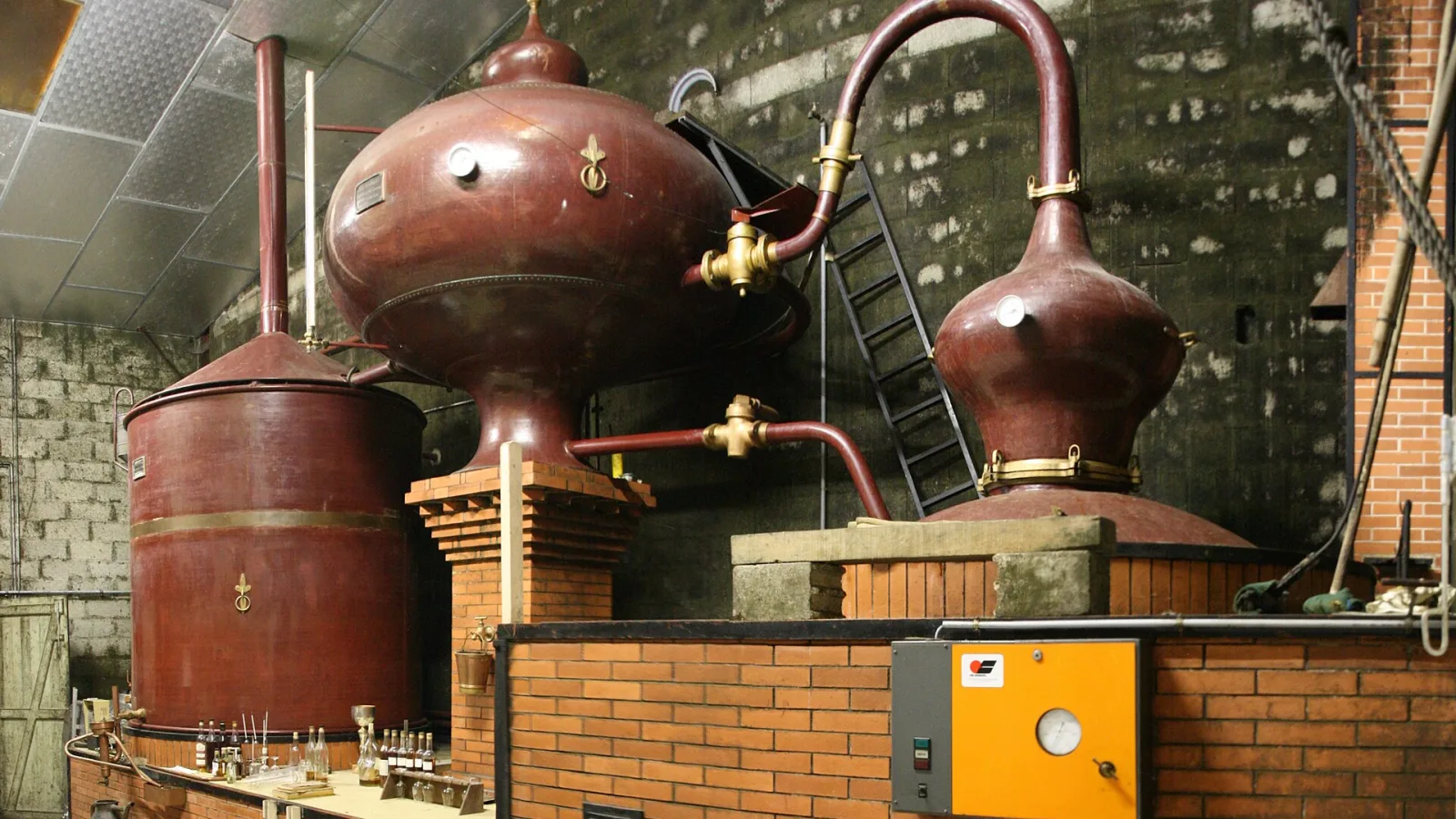
Whisky is distilled from grain, cognac from white grapes. Scotch must mature for at least three years in oak casks of up to 700 litres and be bottled at at least 40 per cent. Cognac is distilled twice in a copper alambic charentais to at most 72.4 per cent and matures for at least two years in oak.
In brief
The key figures
| Raw material for whisky | Grain; Scotch always water and malted barley, possibly with other grains |
|---|---|
| Raw material for cognac | White grapes: ugni blanc, colombard, folle blanche, montils and semillon |
| Distillation of whisky | To less than 94.8 per cent alcohol |
| Distillation of cognac | Double distillation over an open flame in a copper alambic charentais, to at most 72.4 per cent |
| Maturation of whisky | At least three years in Scotland, in oak casks of up to 700 litres |
| Maturation of cognac | At least two years, uninterrupted and exclusively in oak casks |
| Bottling strength | Both at least 40 per cent alcohol |
| Age statement | Whisky in whole years; cognac with VS, VSOP, XO and XXO |
What are whisky and cognac made from?
Whisky comes from grain, cognac from white grapes. Scotch starts with water and malted barley; cognac starts with wine from five permitted grape varieties from the Charente.
With whisky, starch is first converted into fermentable sugars, after which yeast turns them into alcohol. With cognac, the sugar is already in the grape. The cahier des charges of the AOC Cognac names colombard, folle blanche, montils, semillon and ugni blanc; in practice ugni blanc is by far the most planted, because it stays acidic and low in alcohol and therefore distils well.
How does the distillation differ?
Scotch may be distilled to just under 94.8 per cent and the law does not prescribe a still shape. Cognac must go twice through a copper alambic charentais over an open flame.
For cognac the regulations also fix the dimensions: the still may be at most 30 hectolitres and the charge at most 25 hectolitres. After the second run the eau-de-vie may not be stronger than 72.4 per cent at 20 degrees. Distillation must be finished by 31 March after the harvest. For Scotch only the upper limit of 94.8 per cent determines the leeway, and that is so much higher that more styles are possible.
How long must whisky and cognac mature?
Scotch must mature for at least three years in Scotland, in oak casks of at most 700 litres. Cognac must mature for at least two years, uninterrupted and exclusively in oak.
For Scotch, besides oak, the law also prescribes the place: everything happens within Scotland, in an excise warehouse. For cognac the emphasis lies on the wood and on uninterrupted maturation; the regulations speak of vieillissement without interruption, exclusively in oak casks. Neither may ultimately be weaker than 40 per cent in the bottle.
What do VS, VSOP and XO mean?
VS stands for at least two years of maturation, VSOP for at least four years and XO for at least ten years. XXO is used from fourteen years.
The statements refer to the youngest eau-de-vie in the blend, just as an age on a whisky bottle indicates the youngest whisky. XO used to be six years; since 2018 it has been ten. Whisky has no such letter designations: the bottle shows a number in whole years, or no age at all. So both systems say something about the floor of the blend, not about the average.
Which legislation applies to each?
For Scotch, the Scotch Whisky Regulations 2009 apply. For cognac, the cahier des charges of the protected designation of origin applies, overseen by INAO and the Bureau National Interprofessionnel du Cognac.
Both are protected geographical indications: the name may only be used for a product made in the designated area according to the laid-down method. Whisky as a generic name is not protected and is made all over the world; Scotch and Cognac are protected. So anyone who distils grapes in the Netherlands and puts the spirit in oak makes a grape brandy, but never cognac.
From the shop in Bathmen
How much cognac is there in Bathmen?
In the shop in Bathmen there are 147 cognacs from 33 different brands and 5 countries. Prices range from € 6.99 to € 2,599.00. Alcohol content ranges from 17% to 61.3%.
- Bache Gabrielsen Cognac Vsop Triple Cask 40% · 100 cl · France
- Bache Gabrielsen Revelatie Lot.20 Limited Edition 42.1% · 50 cl · France
- BARON OTARD Cognac Extra 1795 40% · 70 cl · France
- Baron Otard Cognac V.S. 40% · 70 cl · France
- Baron Otard VSOP 40% · 70 cl · France
- Belle de Brillet Cognac Likeur 30% · 70 cl · France
- Braastad Cognac VSOP 40% · 70 cl · France
- Braastad Cognac XO 40% · 70 cl · France
- BRAASTAD VS Cognac 40% · 70 cl · France
- Brouwhoeve Cognac Cheval D'or VSOP 40% · 50 cl · Spain
Related questions
Which grapes go into cognac?How do you drink cognac?How long does cognac keep after opening?
Short answer
Short answers to related questions
- Is cognac the same as brandy?
- Cognac is a brandy, but only from the demarcated area around Cognac and made according to the cahier des charges.
- What is the difference between cognac and armagnac?
- Armagnac comes from a different area and is usually distilled in a continuous column still instead of twice in an alambic charentais.
- May cognac be older than the statement says?
- Yes. VS, VSOP and XO indicate a minimum for the youngest eau-de-vie in the blend.
- Why is whisky often distilled to a higher strength than cognac?
- The law allows it: Scotch may go up to almost 94.8 per cent, cognac not above 72.4 per cent.
The reasoning
Sources
- The Scotch Whisky Regulations 2009, regulation 3, legislation.gov.uk (accessed 4 September 2026)
- Cahier des charges de l appellation d origine controlee Cognac, INAO (accessed 4 September 2026)
- Une origine controlee: Cognac VS, VSOP et XO, Bureau National Interprofessionnel du Cognac (accessed 4 September 2026)
Deze pagina is geschreven en gecontroleerd door ’t Bockje Bathmen, slijterij aan de Brink 2 in Bathmen. Laatst bijgewerkt op 31 oktober 2026.
Verkoop van alcohol onder de 18 jaar is verboden. NIX18.