
Cognac · Explainer
What is cognac?
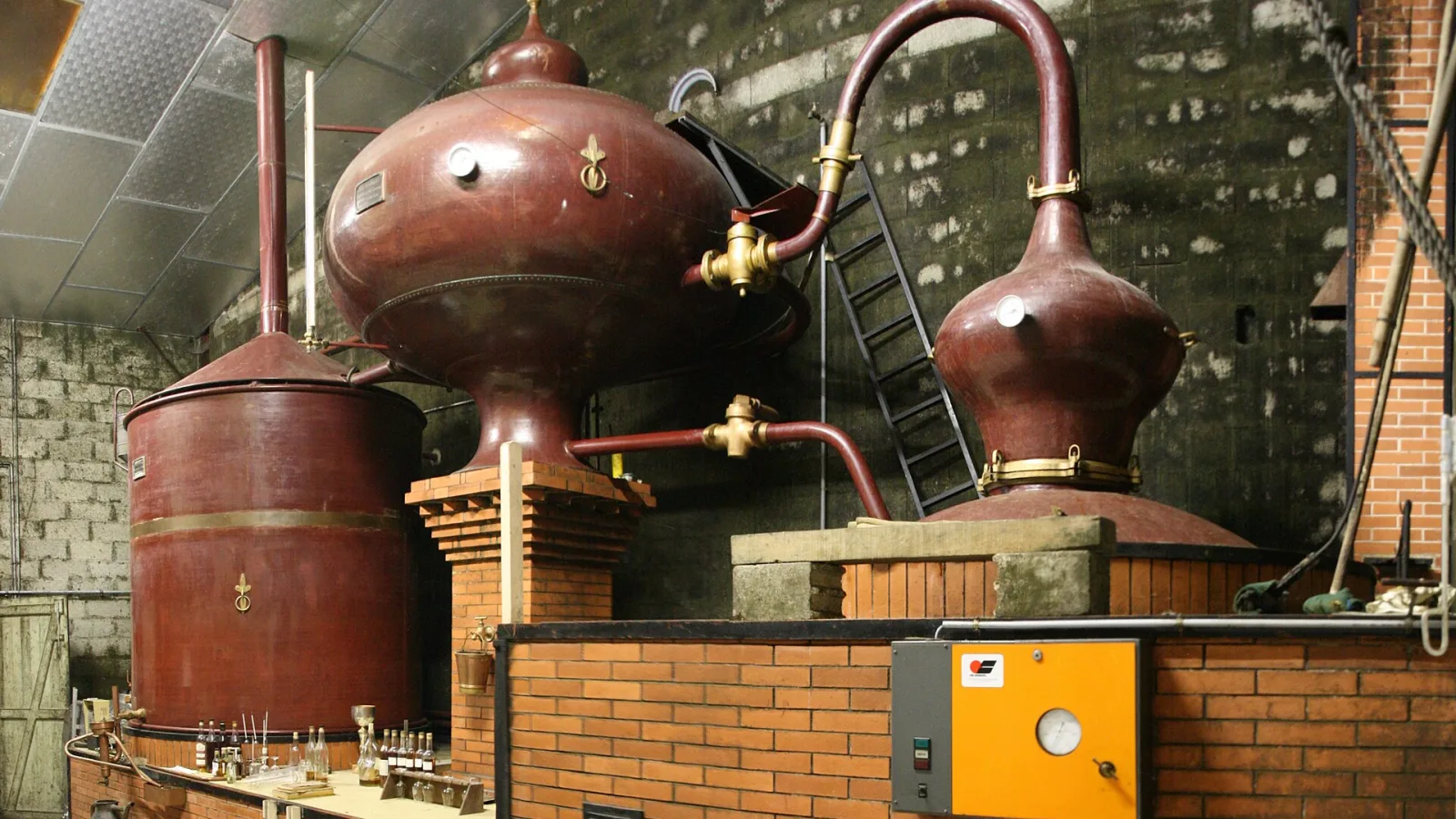
Cognac is a wine distillate with protected origin from the delimited area around the town of Cognac, in the French departments of Charente and Charente-Maritime. The white wine passes twice through a copper alambic charentais. The distillate then matures for at least two years without interruption in oak. When placed on the market, cognac contains at least 40 percent alcohol. The area has six crus.
In brief
The key figures
| Area | Delimited area around the city of Cognac: Charente-Maritime, Charente and a few municipalities in Dordogne and Deux-Sèvres |
|---|---|
| Grape varieties | Ugni blanc (almost 98 percent of the vineyard), colombard, folle blanche, montils, sémillon; folignan up to 10 percent |
| Distillation | Twice, in a copper alambic charentais; finished no later than 31 March after the harvest |
| Minimum maturation | Two years uninterrupted in oak casks, the first two years within the area |
| Minimum alcohol | 40 percent vol. when placed on the market |
| Crus | Grande Champagne, Petite Champagne, Borderies, Fins Bois, Bons Bois, Bois Ordinaires |
| Age statements | VS 2 years, VSOP 4 years, XO 10 years, XXO 14 years |
| Age limit in the Netherlands | NIX18: geen alcohol onder de 18 |
What makes a wine distillate cognac?
Cognac is the legally protected name for a wine distillate that meets the French specification of the appellation d’origine contrôlée Cognac.
That name is not a style designation but a legal one. European Regulation 2019/787 determines how spirit drinks may be named and presented and how geographical indications are protected. Within that, the French specification lays down what must be in the bottle.
If cognac is on the label, the distillate is made from wine from the delimited area, distilled by the prescribed method and matured for the prescribed period. A wine distillate from outside that area may not bear the name, however carefully it is made. The names eau-de-vie de Cognac and eau-de-vie des Charentes are protected in the same way.
Where may cognac come from?
Cognac may only come from the delimited area around the town of Cognac, which lies mainly in Charente-Maritime and Charente and extends into Dordogne and Deux-Sèvres.
The delimitation goes back to a French decree of 1909 and is still in the specification of the appellation. Within that area lie six crus: Grande Champagne, Petite Champagne, Borderies, Fins Bois, Bons Bois and Bois Ordinaires, which may also be called Bois à terroirs.
Fine Champagne is also permitted as a designation, but it is not a region. It is a blend of Grande and Petite Champagne. The maturation is also tied to the area: the first two years must take place within the boundaries of the area. If you want to know how those regions differ from one another, you will find that on our page about the cognac regions.
How is cognac made?
Cognac is made by distilling white wine twice in a copper alambic charentais, a still whose specifications prescribe the shape and the method.
The first run yields a rough brouillis. It goes back into the still for the second run, the bonne chauffe, in which the distiller removes the heads and tails and keeps only the middle part.
For the wine, ugni blanc, colombard, folle blanche, montils and sémillon are permitted, with folignan up to a maximum of ten percent of the vineyard area. Ugni blanc is dominant: the specification states that this variety covers almost 98 percent of the vineyard. That variety gives a pale wine with plenty of acidity and little alcohol, so that a lot of wine goes into a liter of distillate. Only wine from the current harvest campaign qualifies, and the distillation must be completed by 31 March of the year after the harvest at the latest.
How long must cognac mature before it may be sold?
Before being sold to the consumer, cognac must mature for at least two years without interruption in oak casks, and those first two years take place within the delimited area.
Maturation begins no later than one month after the end of the distilling campaign and takes place exclusively in oak wood. The specification links every age statement on the label to a minimum age, expressed in the French compte system.
Converted into years, it comes down to this: Very Special stands for a minimum of two years, Very Superior Old Pale for a minimum of four years, Extra Old for a minimum of ten years and XXO for a minimum of fourteen years. When placed on the market, a cognac must also contain at least 40 percent alcohol. Lower is not permitted within the appellation.
What is the difference between cognac, armagnac and brandy?
Cognac, armagnac and brandy are all three wine distillates, but only cognac and armagnac are protected designations of origin with their own French specification.
Brandy is a general designation for spirits distilled from wine. That name says nothing about a region, nothing about a grape variety and nothing about a distillation method. Armagnac comes from Gascony in the south-west of France and falls under its own appellation with its own requirements.
Cognac is thus the most narrowly defined of the three: a delimited area, a fixed list of grape varieties, double distillation in a copper alambic charentais, at least two years in oak and at least 40 percent alcohol. Anyone who sees only the word brandy on a label therefore knows much less about the bottle than someone who sees the word cognac.
From the shop in Bathmen
Which cognac is on the shelf in Bathmen?
The shop in Bathmen stocks 139 cognacs from France from 32 different brands. Prices range from € 6.99 to € 9,899.00. The alcohol percentage ranges from 17% to 46.7%.
- Bache Gabrielsen Cognac Vsop Triple Cask 40% · 100 cl · France
- Bache Gabrielsen Revelatie Lot.20 Limited Edition 42.1% · 50 cl · France
- BARON OTARD Cognac Extra 1795 40% · 70 cl · France
- Baron Otard Cognac V.S. 40% · 70 cl · France
- Baron Otard VSOP 40% · 70 cl · France
- Belle de Brillet Cognac Likeur 30% · 70 cl · France
- Braastad Cognac VSOP 40% · 70 cl · France
- Braastad Cognac XO 40% · 70 cl · France
- BRAASTAD VS Cognac 40% · 70 cl · France
- Camus Cognac Return to Saint-Aulave 43% · 70 cl · France
Related questions
What are the cognac regions?Which grapes go into cognac?How do you drink cognac?
Short answer
Short answers to related questions
- How do you drink cognac?
- Cognac is usually served neat in a tulip-shaped glass at room temperature, and a few drops of water make the aromas more accessible. Our page on drinking Cognac has the serving advice in more detail.
- What are the cognac regions?
- The delimited area consists of six crus: Grande Champagne, Petite Champagne, Borderies, Fins Bois, Bons Bois and Bois Ordinaires. What each region does to the style of the cognac, you can read on our page about the cognac regions.
- What do VS, VSOP and XO mean?
- VS stands for at least two years of maturation, VSOP for at least four years and XO for at least ten years. The full list of permitted designations is on our page about VS, VSOP and XO.
- Why is there no year on cognac?
- Blending eaux-de-vie of different ages is part of making cognac, and then a single harvest year does not fit on the label. A millésime is allowed, however, under separate conditions; our page about the vintage year explains that.
The reasoning
Sources
- Verordening (EU) 2019/787 betreffende de definitie, presentatie en etikettering van gedistilleerde dranken, European Union, EUR-Lex (accessed 2026-10-14)
- Cahier des charges van de appellation d'origine contrôlée Cognac, gehomologeerd bij besluit van 21 maart 2024, Ministère de l'Agriculture et de la Souveraineté alimentaire, Bulletin officiel (accessed 2026-10-14)
- A protected origin: afbakening, rijping en ouderdomsaanduidingen van Cognac, Bureau National Interprofessionnel du Cognac (accessed 2026-10-14)
- Dossier Cognac in het EU-register van geografische aanduidingen (eAmbrosia), European Commission, eAmbrosia (accessed 2026-10-14)
This page was written and checked by ’t Bockje Bathmen, wine & spirits shop at Brink 2 in Bathmen. Last updated on 14 October 2026.
Verkoop van alcohol onder de 18 jaar is verboden. NIX18.