
Alcohol-free bubbles
Alcohol-free champagne does not legally exist. Champagne is a protected designation of origin, and European rules only allow partial dealcoholisation for such wines. What does exist is sparkling wine from which the alcohol has been removed after fermentation. The label then says 'dealcoholised', at no more than 0.5 percent alcohol. In the shop on the Brink in Bathmen there are currently 5 bottles of alcohol-free bubbles from Spain and France.
- 5bottles in the shop
- 4brands
- 2countries
Does alcohol-free champagne exist?
No. Since a decree of 1936, Champagne has been a recognised French designation of origin (AOC). The Comité Champagne, founded in 1941, has protecting that name worldwide as one of its core tasks. The specifications prescribe, among other things, a strictly delimited area, a second fermentation in the bottle and a minimum ageing of 15 months, or 36 months for a vintage.
On top of that comes the European rule: wines with a protected designation of origin may only be partially dealcoholised. A fully dealcoholised bottle falls outside the rules for protected designations and therefore may not carry the name champagne. Anyone looking for alcohol-free champagne ends up, in practice, with alcohol-free sparkling wine from other regions.
How is wine dealcoholised?
First ordinary wine is made, then the alcohol is removed. In 2012 the international wine organisation OIV laid down which separation techniques are permitted for this: partial vacuum evaporation, membrane techniques and distillation. Regulation (EU) 2021/2117 refers to the OIV resolutions for dealcoholisation.
The OIV sets conditions for it. Wine with a sensory defect may not be dealcoholised, removing alcohol may not go hand in hand with raising the sugar content in the corresponding must, and the process is supervised by an oenologist or specialised technician. How much alcohol is removed depends on the product category the maker has in mind.
Alcohol-free sparkling drinks at ’t Bockje
A selection of the 5 bottles currently in the shop on the Brink.




In brief
| Champagne | Protected designation of origin (AOC) since 1936 |
|---|---|
| De-alcoholised | At most 0.5 percent alcohol (Regulation (EU) 2021/2117) |
| Partially dealcoholised | Above 0.5 percent, below the minimum of the original category |
| 0,0 % | From 19 September 2027: alcohol-free with at most 0.05 percent (Regulation (EU) 2026/471) |
| Techniques (OIV) | Partial vacuum evaporation, membrane techniques, distillation |
| Protected designations | Only partial dealcoholisation permitted |
| In the shop | 5 bottles |
What do dealcoholised, alcohol-free and 0.0 mean?
At present the designation 'dealcoholised' applies to wine products with an actual alcoholic strength of no more than 0.5 percent. If the strength is above 0.5 percent but below the minimum of the original category, it is called 'partially dealcoholised'. This is laid down in Regulation (EU) 2021/2117, which also amended the rules on protected names.
These terms are changing. Regulation (EU) 2026/471 of 24 February 2026 replaces them with ‘alcohol-free’ up to and including 0.5 percent, with the addition ‘0.0 %’ if the content does not exceed 0.05 percent. Above 0.5 percent a separate statement for reduced alcohol is introduced, if the content is at least 30 percent below the minimum of the original category. These labelling rules apply from 19 September 2027; bottles labelled earlier may be sold until stock runs out.
Can prosecco or cava be on an alcohol-free bottle?
Not as a protected designation. Prosecco and cava are, like champagne, protected designations of origin. Under Regulation (EU) 2021/2117, such wines may only be partially dealcoholised, and the rules for protected designations do not apply to sparkling wine that has undergone full dealcoholisation. A bottle with 0.0 percent is therefore not prosecco or cava in the legal sense.
Labels therefore usually say 'sparkling' or 'alcohol-free sparkling', sometimes with the name of the house or the grape added. The Catalan house Vilarnau, for example, describes its 0.0 as a sparkling made from parellada and macabeo from Vilarnau d’Espiells’ own vineyards. A partially dealcoholised wine can, however, keep the protected name if the product specification of that designation allows it.
Which alcohol-free bubbles does the shop stock?
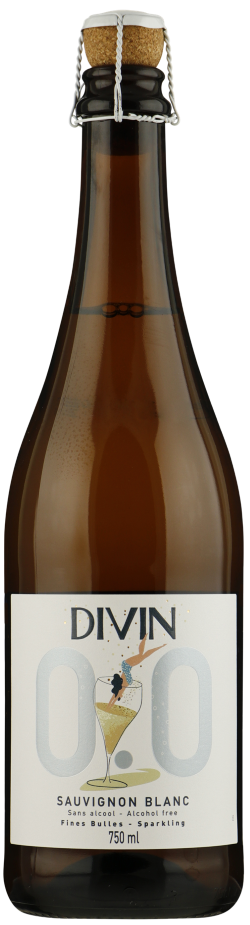
The shop currently has 5 bottles of alcohol-free sparkling wine, from Spain and France. From Spain come the Vilarnau Brut 0.0% and the Vilarnau Rosé 0.0%; the white is, according to the house, made from parellada and macabeo. Freixenet is represented with the Alcohol Free Sparkling Rosé. The Al Mercado Brut Blanco 0.0 De-Alcoholized Sparkling and the DIVIN Sparkling Sauvignon Blanc are also on the shelf. The exact alcohol content is on the label of every bottle; feel free to ask if you would like to know what a statement means.
Would you like to know what is on a label, or are you looking for something alcohol-free for a party or a toast? Feel free to call or drop by ’t Bockje at Brink 2 in Bathmen.
Brands in this selection
- Vilarnau Cava 2
- Al Mercado 1
- Divin 1
- Freixenet 1
What customers also ask
Why is it not called alcohol-free champagne?
Champagne is a protected designation of origin, and under EU rules such wines may only be partially dealcoholised.
Is alcohol-free sparkling wine really wine?
It starts as wine; the alcohol is then removed by vacuum evaporation, membrane techniques or distillation.
What is the difference between 0.0 and alcohol-free?
From 19 September 2027, alcohol-free means at most 0.5 percent; the designation 0.0 % may only be used at a maximum of 0.05 percent.
Is there alcohol-free prosecco or cava?
Not as a protected designation: a fully dealcoholised bottle falls outside the rules for prosecco and cava.
How many alcohol-free bubbles are in the shop?
Currently 5 bottles, from Spain and France.
Keep browsing
Sources
- Verordening (EU) 2021/2117, Europese Unie (EUR-Lex), eur-lex.europa.eu/legal-content/NL/TXT/HTML/?uri=CELEX:32021R2117 (accessed 7 October 2026)
- Verordening (EU) 2026/471, Europese Unie (EUR-Lex), eur-lex.europa.eu/legal-content/EN/TXT/HTML/?uri=CELEX:32026R0471 (accessed 7 October 2026)
- Resolution OIV-OENO 394A-2012: Dealcoholisation of wines, OIV, oiv.int/public/medias/1431/oiv-oeno-394a-2012-en.pdf (accessed 7 October 2026)
- Factsheet: The Champagne Appellation (AOC), Comité Champagne, champagne.education/sites/default/files/2026-08/Factsheet%20-%20The%20Champagne%20Appellation%20%28AOC%29.pdf (accessed 7 October 2026)
The shop is at Brink 2 in Bathmen. Open Tuesday to Friday from 09.00 to 18.00 and Saturday from 09.00 to 17.00. For advice, call 0570 541 278 or email info@bockje.nl.
Wij verkopen geen alcohol aan personen onder de 18 jaar. NIX18.