Drinks advice
Tarta de Santiago with Valdespino Moscatel Promesa
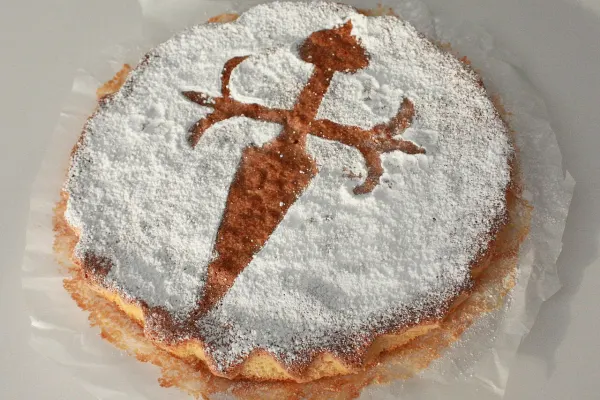
On the plate lies a wedge of almond tart with lemon zest and cinnamon, dusted with icing sugar and with the Cross of St James left bare in it. Opposite stands a moscatel: a sweet sherry with blossom, honey and citrus, which carries the almond and the lemon on in the glass.
From the shelf
The bottle
Promesa comes from Valdespino and is a moscatel, made from Moscatel grapes from Chipiona on the Atlantic coast near the sherry region. Here too the grapes are laid out in the sun to turn into raisins, the asoleo, which concentrates the sugar and the raisin aromas; fermentation is then stopped with grape spirit. The wine ages for four years oxidatively in the system of criaderas and soleras, in old American oak casks that previously held amontillado and oloroso. The bottle is at 17 percent alcohol with 237 grams of residual sugar per litre and comes in 75 centilitres; the Consejo Regulador sets more than 160 grams of residual sugar per litre for moscatel.
The combination
Why this works together
Tarta de Santiago is a cake without butter and without much flour: most of it is almond meal, and the flavour comes from lemon zest, cinnamon and the roasted almond itself. That is a dry, almost grainy sweetness, and it calls for a wine that brings moisture and floweriness instead of even more toasted notes. A moscatel does exactly that: at 237 grams of residual sugar per litre it is clearly sweet, but that sweetness comes with blossom, honey and citrus, and that citrus runs in step with the lemon zest in the cake. Because the wine has aged oxidatively for only four years, it is less thickened than a Pedro Ximenez and stays fresh enough not to flatten a cake. The sweetness on both sides does not fight here, because in a mixture sweetness mainly suppresses the other flavours and hardly itself. The Consejo Regulador mentions desserts, fruit and cream ice cream for moscatel, and Valdespino itself desserts with nuts.
At the table
The dish
- For 4 people
- Ready in 1 hour
- Type dessert
What you need
- for the base: 1 egg
- for the base: 60 g fine granulated sugar
- for the base: 1 tablespoon water
- for the base: 125 g flour
- for the base: half a teaspoon of cinnamon
- for the filling: 2 eggs
- for the filling: 125 g fine granulated sugar
- for the filling: 125 g almond flour
- for the filling: the grated zest of half a lemon
- for the filling: half a teaspoon of cinnamon
- icing sugar for dusting
How to make it
- Preheat the oven to 180 degrees. Grease a springform tin of 20 centimetres and dust it with flour.
- For the base, beat the egg with the sugar, the water and the cinnamon. Work in the flour bit by bit until you have a dough you can knead.
- Roll out the dough and lay it in the tin, pressing it against the base and the edge.
- For the filling, beat the two eggs with the sugar and the lemon zest into a frothy mixture. Fold in the almond flour and the cinnamon.
- Pour the filling into the tin and bake the tart for 25 to 30 minutes at 180 degrees.
- Let the tart cool. Place a St James cross cut from cardboard in the middle, dust the tart with icing sugar and carefully lift the cross off.
In the glass
Serving
Serve this moscatel lightly chilled, between 12 and 14 degrees, the temperature the Consejo Regulador gives for this style. A white wine glass or a catavinos of about 200 millilitres is the right size, with just a little in it; it is a dessert in a glass and not a table wine. After opening, a moscatel keeps for about two months, with the bottle closed and stored cool.
Everything about Valdespino Moscatel PromesaBack to Drinks advice from ’t Bockje
Wij verkopen geen alcohol aan personen onder de 18 jaar. NIX18
 Whisky
 Beer
 Wine
 Spirits
 Aperitifs and specialities
 Alcohol-free
 Glasses and more
 Partnerships