
Brandy · Explainer
What is the difference between cognac, armagnac and brandy?
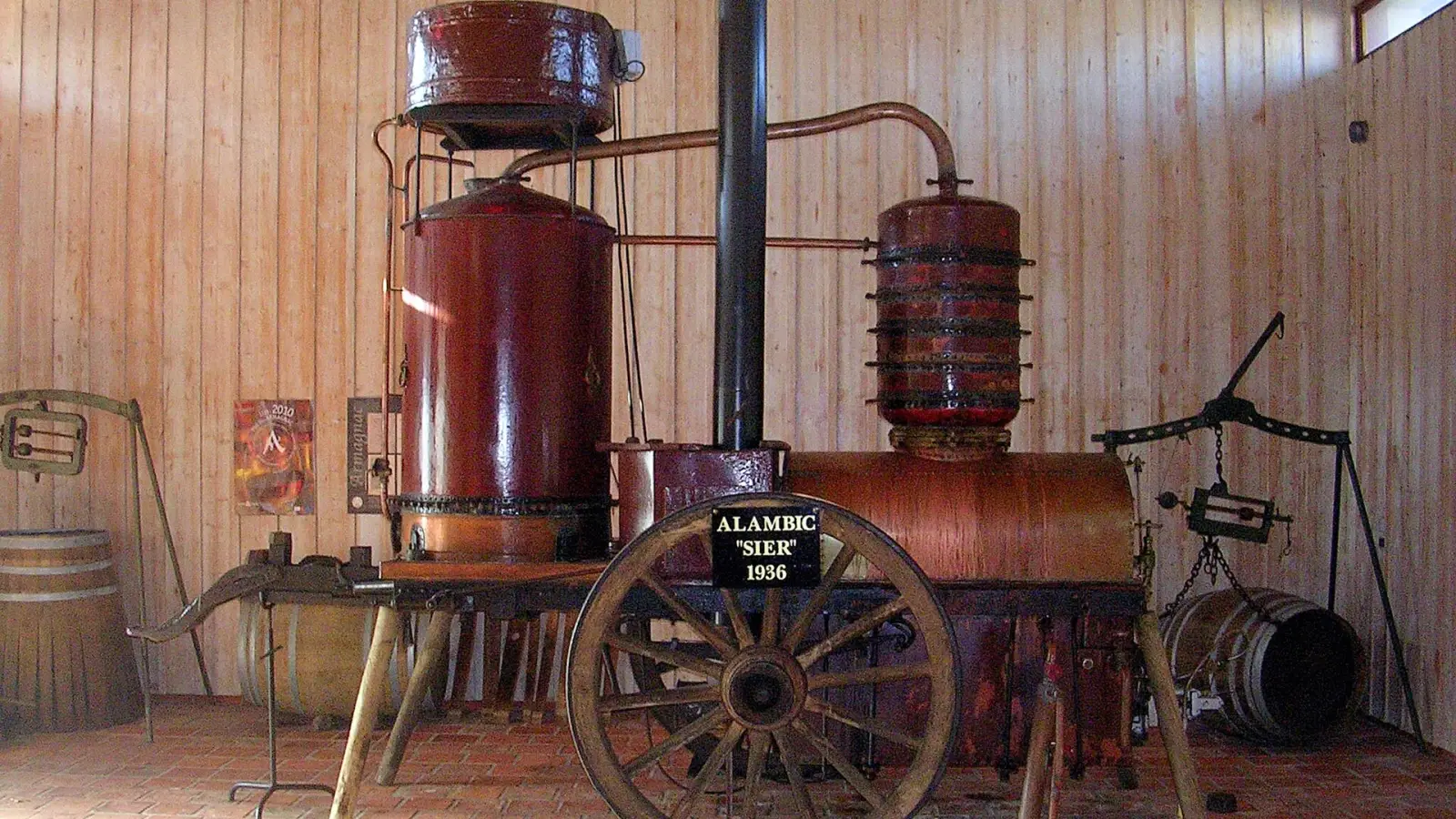
Brandy is the broad European category from Regulation (EU) 2019/787, with at least 36 per cent alcohol and compulsory ageing in oak. Cognac and armagnac are protected French designations of origin within that family. Cognac is distilled twice in an alambic charentais, armagnac usually in a single continuous run through an alambic armagnacais.
In brief
The key figures
| Brandy | category 5 of Regulation (EU) 2019/787, minimum 36 per cent alcohol |
|---|---|
| Brandy ageing | at least one year in oak casks of 1,000 litres or more, or six months in smaller casks |
| Wine spirit | category 4, minimum 37.5 per cent alcohol, distillation below 86 per cent |
| Distillation of cognac | twice in an alambic charentais, distillate at most 72.4 per cent |
| Cognac still | chaudière of at most 30 hectolitres |
| Armagnac distillation | continuously in an alambic armagnacais, distillate between 52 and 72.4 per cent |
| Armagnac areas | Bas Armagnac, Armagnac-Tenareze and Haut Armagnac |
| Distillation end date | by 31 March after the harvest at the latest, in both areas |
What is brandy under European law?
Brandy is category 5 in Regulation (EU) 2019/787: a drink made from wine spirit, with at least 36 per cent alcohol and compulsory ageing in oak.
The regulation requires at least one year of ageing in oak casks of 1,000 litres or more, or six months in smaller oak casks. Adding alcohol is not allowed and colouring is only permitted with caramel. The raw material, wine spirit from category 4, is distilled below 86 per cent.
How does the distillation of cognac and armagnac differ?
Cognac goes through an alambic charentais twice, the so-called repasse. Armagnac usually goes through an alambic armagnacais in a single continuous run.
The cognac cahier des charges caps the distillate at 72.4 per cent at 20 degrees and limits the chaudière to 30 hectolitres. For armagnac the distillate lies between 52 and 72.4 per cent. In both appellations distillation must be completed by 31 March after the harvest at the latest.
Which areas and grapes belong to it?
Cognac comes from the Charente, with geographical names such as Grande Champagne, Petite Champagne, Borderies, Fins Bois and Bons Bois. Armagnac comes from Gascony.
For cognac, permitted varieties include ugni blanc, colombard, folle blanche, semillon and montils, with folignan up to at most 10 per cent of plantings. Armagnac has Bas Armagnac, Armagnac-Tenareze and Haut Armagnac. Baco blanc and ugni blanc are the main varieties there, alongside folle blanche and colombard.
What do VS, VSOP and XO mean?
For cognac, VS stands for at least two years of ageing, VSOP for four years, XO for ten years and XXO for fourteen years, counted from the youngest eau-de-vie in the bottle.
The Bureau National Interprofessionnel du Cognac manages that age count. For armagnac, XO and Hors d'Age require a minimum of ten years, and a millésime carries a single harvest year, also with at least ten years of ageing. The ageing of armagnac starts counting on 1 April after the harvest.
Is every brandy a cognac?
No. Cognac and armagnac are protected designations of origin within the wider brandy category. Every cognac is a brandy, but not every brandy may call itself cognac.
A bottle that is simply called brandy need only meet the requirements of category 5. If you want to know the area, grapes and distilling method, read the appellation on the label. Other countries also have their own protected names, such as brandy de Jerez in Spain.
From the shop in Bathmen
Brandy in the shop in Bathmen
The shop in Bathmen has 66 brandies from 28 different brands from 9 countries. The alcohol percentage ranges from 20% to 45%.
- Ararat 10 Years Old Akhtamar 40% · 70 cl · Various
- Asbach 15 40% · 70 cl · Germany
- Asbach 8 40% · 70 cl · Germany
- Asbach Uralt Original 3 Years Old Brandy 38% · 70 cl · Germany
- Asbach Uralt Weinbrand 38% · 70 cl · Germany
- Asbach Uralt Weinbrand 36% · 100 cl · Germany
- Brandy Lepanto Gran Reserva 36% · 70 cl · Spain
- Caffo Brandy 1964 Stravecchio Gran Riserva Cinquant'anni 45% · 70 cl · Italy
- CAFFO Italiaanse brandy 46 Years Old Vintage 1970 42% · 70 cl · Italy
- Caffo Miss Dominique Brandy Arzente Riserva 40% · 70 cl · Italy
Related questions
What is Spanish brandy de Jerez?Can you buy a bottle from your year of birth?What is armagnac?
Short answer
Short answers to related questions
- What is the difference between cognac and whisky?
- Cognac is distilled from grape wine, whisky from a fermented grain mash. Both mature in oak, but the raw material and the distillation rules differ.
- What is a millésime in armagnac?
- An armagnac from a single harvest year. The year is on the label and the eau-de-vie has then spent at least ten years in wood.
- Does brandy continue to mature in the bottle?
- No. Ageing happens in the wooden cask. Once the bottle is filled and sealed, the contents hardly change any more.
- What is Fine Champagne?
- A cognac blended exclusively from the Grande Champagne and Petite Champagne crus.
- Why do the regulations mention 31 March?
- Both appellations close the distilling season. The distillation of a harvest must be completed by 31 March of the following year at the latest.
The reasoning
Sources
- Regulation (EU) 2019/787 on spirit drinks, EUR-Lex (accessed 4 September 2026)
- Cahier des charges de l appellation d origine controlee Cognac, INAO (accessed 4 September 2026)
- Cahier des charges de l'appellation d'origine contrôlée Armagnac, INAO (accessed 4 September 2026)
- Une origine controlee: Cognac VS, VSOP et XO, Bureau National Interprofessionnel du Cognac (accessed 4 September 2026)
Deze pagina is geschreven en gecontroleerd door ’t Bockje Bathmen, slijterij aan de Brink 2 in Bathmen. Laatst bijgewerkt op 26 oktober 2026.
Verkoop van alcohol onder de 18 jaar is verboden. NIX18.