
Brandy · Explainer
What is armagnac?
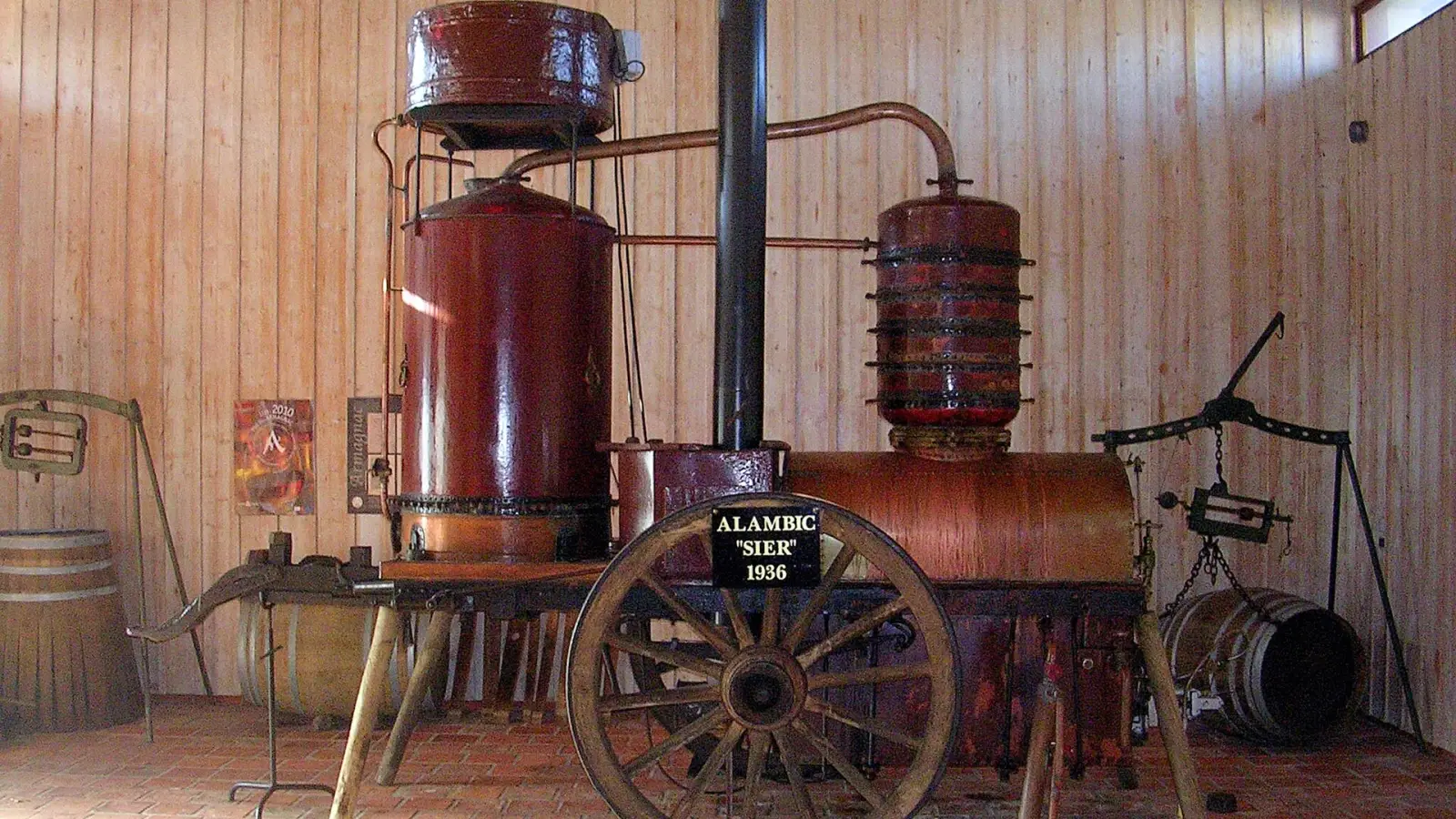
Armagnac is a French grape brandy from Gascony, recognised as a designation of origin since 1936. The wine is distilled in a single pass in an alambic armagnacais, up to a maximum of 72.4 percent alcohol. The eau-de-vie then matures for at least a year in oak, often in casks of 420 litres. For bottling, 40 percent applies as the minimum. The area has three regions.
In brief
The key figures
| What it is | French grape brandy from Gascony |
|---|---|
| Designation of origin since | 1936 |
| Regions | Bas Armagnac, Armagnac Tenareze, Haut Armagnac |
| Distillation | Continuous, in an alambic armagnacais |
| Maximum at distillation | 72.4 percent alcohol |
| Minimum maturation | One year on oak from 1 April after the harvest |
| Cask size | Oak, often 420 litres |
| Minimum at bottling | 40 percent alcohol |
Where does armagnac come from?
Armagnac comes from Gascony in the southwest of France and has been recognised there as a designation of origin since 1936.
The area lies between the Landes and the Gers, inland from Bordeaux. The name armagnac may only appear on the bottle when the grapes, wine and distillation come from that delimited area. The Ministere de la Culture included the production method in the inventory of intangible heritage.
Which three regions does armagnac have?
The appellation has three regions: Bas Armagnac in the west, Haut Armagnac in the east and Armagnac Tenareze in between.
Each region may appear as a supplementary designation on the label, when the whole bottle comes from there. If it says only Armagnac, the eau-de-vie may come from the entire area. The three names are in the cahier des charges managed by the INAO.
How is armagnac distilled?
Armagnac is distilled continuously in an alambic armagnacais, a column still, to at most 72.4 percent alcohol.
The cahier des charges stipulates that distillation must be finished by 31 March of the year after the harvest at the latest. The eau-de-vie comes out of the still colourless. Because distilling is done in a single pass and drawn off at a lower strength, more of the wine remains in the distillate than would be the case with a second pass.
How long must armagnac mature?
Armagnac matures for at least a year on oak, counted from 1 April of the year after the harvest.
The casks in the Armagnac often hold 420 litres. For part of the time the eau-de-vie lies in new wood, then in older wood that gives off less colour and tannin. Higher minimums apply to the commercial designations: XO and Hors d’Age require at least ten years, and a vintage according to the trade organisation likewise ten years.
Which grapes are permitted in armagnac?
Ten white grape varieties are permitted for armagnac, including ugni blanc, baco blanc, folle blanche and colombard.
The full list in the cahier des charges also names blanc dame, graisse, jurançon, mauzac, mauzac rose and meslier saint-françois. Baco blanc is a cross that is permitted in Armagnac and not in many other French appellations. The choice of variety is therefore part of the regulations, not of taste alone.
How does armagnac differ from cognac?
Armagnac is distilled in a single pass and cognac twice, in an alambic charentais.
Both are French grape brandies and both must have at least 40 percent alcohol when sold. The area differs: armagnac comes from Gascony, cognac from the Charente. The classification also differs. Cognac has six crus and, since 2018, the XXO grade from fourteen years; armagnac has three regions and also works a lot with vintages.
From the shop in Bathmen
Which armagnacs are there in Bathmen?
The shop in Bathmen stocks 35 armagnacs from 13 different brands. Prices range from € 21.99 to € 224.99. The alcohol percentage ranges from 40% to 50.5%.
- Armagnac de Montal VS 40% · 70 cl · France
- Armagnac de Montal VSOP 40% · 70 cl · France
- Armagnac de Montal XO 40% · 70 cl · France
- Armagnac Delord 25 Years Old 40% · 70 cl · France
- Armagnac Delord Fine 3 Years Old 40% · 70 cl · France
- Armagnac Delord Napoleon 10 Years Old 40% · 70 cl · France
- Armagnac Delord VSOP 5 Years Old 40% · 70 cl · France
- Armagnac Delord XO 15 Years Old 40% · 70 cl · France
- Armagnac Delord XO Premium 25-45 Years Old 42% · 70 cl · France
- Cartron Marc de Bourgogne Hors d'age 15 Ans 45% · 70 cl · France
Related questions
What is a millésime armagnac?What is the difference between cognac, armagnac and brandy?What is pisco?
Short answer
Short answers to related questions
- Is armagnac the same as cognac?
- No. Both are French grape brandies, but armagnac comes from Gascony and is distilled in one pass; cognac comes from the Charente and is distilled twice.
- What does Bas Armagnac mean?
- Bas Armagnac is the western area of the Armagnac designation of origin. The name may appear on the label when the entire bottle comes from there.
- What does XO mean for armagnac?
- XO stands for armagnacs whose youngest eau-de-vie has matured for at least ten years. Hors d’Age has the same lower limit.
- What is the minimum alcohol content of armagnac?
- At bottling, 40 percent is the minimum.
The reasoning
Sources
- Cahier des charges AOC Armagnac, INAO (accessed 2026-09-06)
- L'elaboration de l'eau-de-vie d'Armagnac, Ministere de la Culture, inventaire du patrimoine culturel immateriel (accessed 2026-09-06)
- Hors d'Age and XO, Bureau National Interprofessionnel de l'Armagnac (accessed 6 September 2026)
- How to read a label, Bureau National Interprofessionnel de l'Armagnac (accessed 2026-09-06)
- Verordening (EU) 2019/787, bijlage I: categorieen gedistilleerde dranken, The National Archives, legislation.gov.uk (accessed 6 September 2026)
This page was written and checked by ’t Bockje Bathmen, wine and spirits shop at Brink 2 in Bathmen. Last updated on 7 September 2026.
Verkoop van alcohol onder de 18 jaar is verboden. NIX18.