
Brandy · Explainer
What is a millésime armagnac?
A millésime armagnac comes from a single harvest year. The year on the bottle is the year in which the grapes were harvested, not the year of bottling. Nothing from other years is blended in. Armagnac matures in oak casks of 400 litres and loses about half a degree of alcohol per year in the process. There are three appellations: Bas-Armagnac, Armagnac-Ténarèze and Haut-Armagnac.
In brief
The key figures
| What it is | Armagnac from a single vintage, without blending with other years |
|---|---|
| What the year means | The harvest year of the grapes |
| Appellations | Bas-Armagnac, Armagnac-Ténèrez and Haut-Armagnac |
| Grape varieties | Ten permitted varieties, including baco blanc, ugni blanc, folle blanche and colombard |
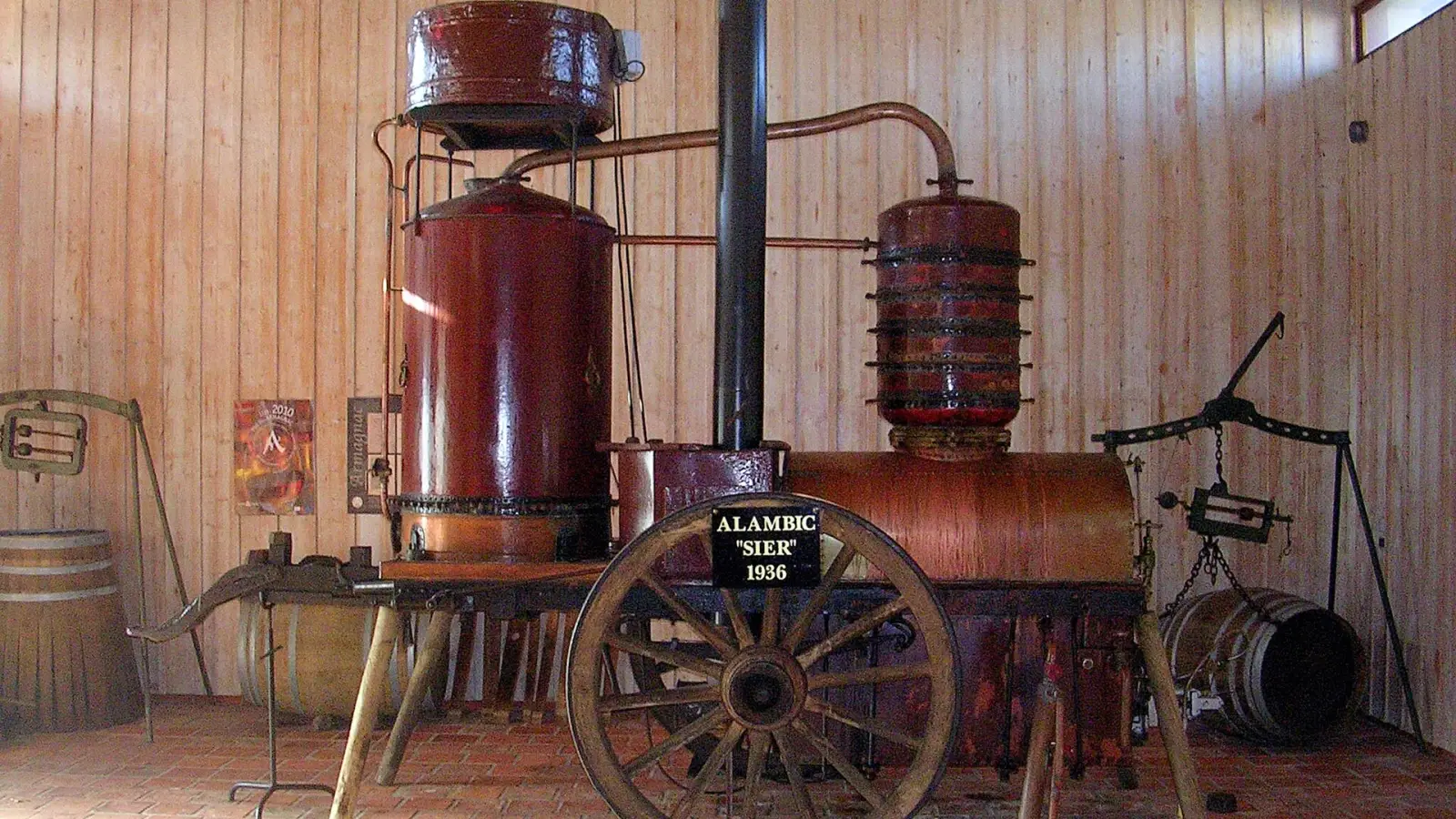
| Distillation | Alambic armagnacais, continuous; responsible for about 95 percent of production |
| Strength after distillation | 52 to 72 percent by volume, traditionally 52 to 60 |
| Ageing | Oak pièces of 400 litres, at least one year in wood |
| Evaporation | About half a degree of alcohol per year |
What does the year on a bottle of armagnac mean?
The year on a millésime armagnac is the harvest year of the grapes from which the eau-de-vie was distilled.
The whole bottle comes from that one year. Nothing is blended in from another harvest year, as does happen with a blend. The Bureau National Interprofessionnel de l’Armagnac describes the millésimes as the natural extension of viticulture, with its cycles and its years.
Also look at the bottling year. Maturation takes place in the cask and stops as soon as the armagnac is in glass. A millésime from 1985 bottled in 2005 has had twenty years of wood, and nothing changes about that in the cupboard.
How does a millésime differ from an XO?
An XO armagnac is a blend whose youngest component has spent at least ten years in wood, whereas a millésime comes from a single harvest year.
With an age statement, the youngest eau-de-vie in the bottle always counts. Article 13 of Regulation (EU) 2019/787 stipulates that a maturation period or age may only be stated if it refers to the youngest alcoholic component.
According to the BNIA, hors d’âge goes beyond ten years and in practice is often above that legal minimum. With a millésime there is nothing to average out: everything in the bottle is the same age.
Which area does a millésime armagnac come from?
Armagnac comes from Gascony and has three appellations: Bas-Armagnac, Armagnac-Ténèrze and Haut-Armagnac.
The INAO's cahier des charges describes those three as separate natural environments, each with its own soil and climate. On the label of a millésime it almost always states which of the three it is.
The wines for the eau-de-vie may come from ten varieties: baco blanc, blanc dame, colombard, folle blanche, graisse, jurançon, mauzac, mauzac rose, meslier saint-françois and ugni blanc. The cahier calls the use of vintages an old and common practice in the region.
How long does a millésime armagnac mature?
Every armagnac must mature for at least one year in oak, and there is no upper limit for a millésime.
Maturation takes place in pièces of 400 litres, made from oak from the forests of Gascony or the Limousin. The BNIA reckons with an evaporation of about half a degree of alcohol per year and mentions maturations of twenty, forty and more years.
As a result, an old vintage slowly drops to a strength at which it can go into the bottle. The longer in the cask, the more colour, tannin and wood aroma the armagnac picks up.
What do you look for when buying a vintage armagnac?
Look out for three things on the label: the harvest year, the bottling year and the appellation.
With the harvest year and the bottling year you can work out for yourself how much time the armagnac has spent in cask. If only the harvest year is on the bottle, ask about it before assuming an age.
The appellation says which part of Gascony the grapes come from. Also look at the alcohol percentage on the bottle: some vintages go into the bottle at cask strength, others are brought to a lower strength.
From the shop in Bathmen
Which armagnacs are in the shop in Bathmen?
In the shop in Bathmen there are 35 armagnacs from 13 different brands. Prices range from € 21.99 to € 224.99. The alcohol percentage ranges from 40% to 50.5%.
- Armagnac de Montal VS 40% · 70 cl · France
- Armagnac de Montal VSOP 40% · 70 cl · France
- Armagnac de Montal XO 40% · 70 cl · France
- Armagnac Delord 25 Years Old 40% · 70 cl · France
- Armagnac Delord Fine 3 Years Old 40% · 70 cl · France
- Armagnac Delord Napoleon 10 Years Old 40% · 70 cl · France
- Armagnac Delord VSOP 5 Years Old 40% · 70 cl · France
- Armagnac Delord XO 15 Years Old 40% · 70 cl · France
- Armagnac Delord XO Premium 25-45 Years Old 42% · 70 cl · France
- Cartron Marc de Bourgogne Hors d'age 15 Ans 45% · 70 cl · France
Related questions
What is pisco?What is Spanish brandy de Jerez?Can you buy a bottle from your year of birth?
Short answer
Short answers to related questions
- Does armagnac get any older in the bottle?
- No. Maturation happens in the cask and stops at bottling. A bottle that sits in your cupboard for ten years is still just as old as on the day of bottling.
- What does VSOP mean on a bottle of armagnac?
- VSOP is an age class for blends. The BNIA applies at least ten years for XO; VSOP is below that. With a millésime there is no class but a vintage year.
- How is armagnac distilled?
- Usually continuously, on an alambic armagnacais. The BNIA puts this at about 95 percent of production, with a distillate of 52 to 72 percent alcohol by volume.
- How many years pass between harvest and bottle?
- That differs per bottle. At least one year of wood is mandatory; for millésimes the BNIA mentions maturations of twenty to forty years.
- Does ’t Bockje sell spirits to young people?
- Nee. Wij verkopen geen alcohol aan mensen onder de 18 jaar en vragen om een legitimatiebewijs. NIX18.
The reasoning
Sources
- Cahier des charges de l'appellation d'origine contrôlée Armagnac, INAO (accessed 2026-09-06)
- Les millésimes, Bureau National Interprofessionnel de l'Armagnac (accessed 2026-09-06)
- XO et Hors d'âge, Bureau National Interprofessionnel de l'Armagnac (accessed 2026-09-06)
- Distillation et vieillissement, Bureau National Interprofessionnel de l'Armagnac (accessed 2026-09-06)
- Verordening (EU) 2019/787, artikel 13, EUR-Lex (accessed 2026-09-06)
This page was written and checked by ’t Bockje Bathmen, wine and spirits shop at Brink 2 in Bathmen. Last updated on 7 September 2026.
Verkoop van alcohol onder de 18 jaar is verboden. NIX18.