Drinks advice
Bitterballen with Bokma Jonge Graanjenever
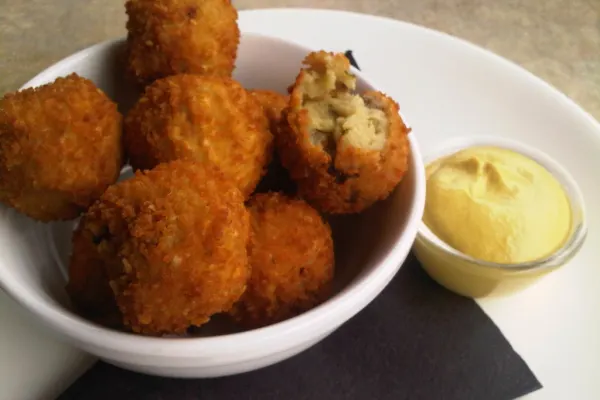
On the plate are bitterballen of home-made beef ragout, crisply fried, with coarse mustard alongside. Opposite stands a young grain jenever that cuts the frying fat from the tongue and brings the ragout back to flavour.
From the shelf
The bottle
Bokma Jonge Graanjenever comes from Bokma, a brand that began in Leeuwarden in 1826 and whose production has been in Zoetermeer since 1987, now under Lucas Bols. It is a young grain jenever of 35% vol in a 100 cl bottle. Bokma was the first young jenever distilled entirely from grains, with rye, wheat and maize. Besides juniper berry, the recipe includes coriander, pepper, angelica and liquorice, among others. For the designation young jenever, at least 35% vol and at least 1.5% alcohol from malt wine apply, with at most 15% malt wine in practice.
The combination
Why this works together
A bitterbal is essentially fat in three layers: butter in the roux, gelatine and meat in the filling, and frying oil in the crust. That fat lays a film on the palate, which is why the second bitterbal always has less flavour than the first. Alcohol dissolves that fat, and a young grain jenever consists largely of neutral grain alcohol, so it does this without adding anything of its own. Had you set an old jenever beside it, the malt of the jenever would have fought with the bound ragout: two soft, round things side by side turn pasty. The juniper, coriander and pepper in the Bokma, on the other hand, go along with the coarse mustard and hold on to the side of the spices. The result is that the fifth bitterbal tastes just as good as the first.
At the table
The dish
- For 4 people
- Ready in 4 hours 30 minutes of preparation, plus 7 hours 30 minutes of chilling
- Type drinks snack
What you need
- 225 g beef short rib pieces
- 190 ml beef stock and 200 ml water
- 1 bay leaf and 1 piece of mace
- 15 g flat-leaf parsley
- 40 g unsalted butter
- 50 g wheat flour, and 10 g extra for coating
- 1 tablespoon coarse mustard
- 3 gelatine leaves
- 2 eggs
- 110 g breadcrumbs
- 1 l frying oil
How to make it
- Put the meat with the stock, the water, the bay leaf, the mace and the parsley in a pan. Bring to the boil and let it simmer gently with the lid on for 3 hours. Then let the meat cool in the stock without the lid for about 3 hours. Take the meat out and pull it apart finely. Strain the stock and measure out 400 ml.
- Melt the butter, add the 50 g flour and cook it for 5 minutes over low heat. Pour in the stock in portions and keep stirring until a thick sauce forms. Let it boil on for 3 minutes until the sauce glistens. Stir in the meat and the mustard and season with pepper and salt.
- Soak the gelatine in cold water for 5 minutes, squeeze out the sheets and stir them into the warm ragout. Pour the ragout into a shallow mould, let it cool to room temperature and then refrigerate the covered mould for 3 hours.
- Divide the cold ragout into about twenty pieces and roll them into little balls. Dip them first in the flour, then in the beaten egg and then in the breadcrumbs; repeat the egg and breadcrumbs for a second coating. Put the balls in the freezer for 30 minutes.
- Heat the oil to 180 °C and fry the bitterballen in batches of ten to twelve for about 4 minutes until golden brown. Let them drain on kitchen paper and serve with coarse mustard.
In the glass
Serving
Pour the Bokma Jonge Graanjenever ice cold from the freezer into a tulip glass or shot glass, filled to the brim. Young genever is served both at room temperature and chilled; with fried snacks chilled works better, because the cold takes the fat off the tongue faster. Fill the glasses only when the bitterballen come to the table.
Everything about Bokma Jonge GraanjeneverBack to Drinks advice from ’t Bockje
Wij verkopen geen alcohol aan personen onder de 18 jaar. NIX18
 Whisky
 Beer
 Wine
 Spirits
 Aperitifs and specialities
 Alcohol-free
 Glasses and more
 Partnerships