
Alcohol-free · Germany · brand
Paulaner Hefe Weizen. Two alcohol-free drinks.
From the shelf
One of the 2
Click on a bottle for the rest of the details.
A weizen without alcohol
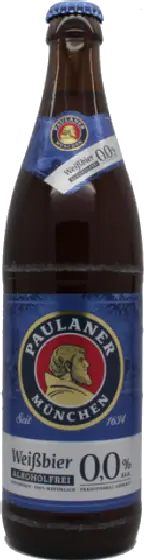
This page is only about Paulaner's alcohol-free range. We have two bottles of it: the familiar half-litre bottle and the smaller 33 centilitre bottle. Both the same Hefe Weizen, both 0.0 percent according to the label.
It is the same beer style as the regular Paulaner Weißbier: top-fermented, brewed with a large share of wheat malt. Only the alcohol content differs.
If you are looking for something else without alcohol, there are 110 alcohol-free drinks on the shelf in Bathmen, from beer and wine to gin and aperitifs.
The two bottles we have in stock
Both 0% vol according to the label information in our online shop, both available for immediate delivery.
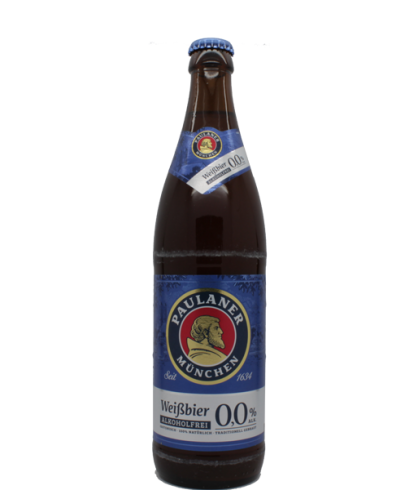
Paulaner Hefe Weizen Alcoholvrij 0.0
Non-alcoholic Hefe Weizen from Munich. 50 centilitres, 0.0 percent.
€ 1,75
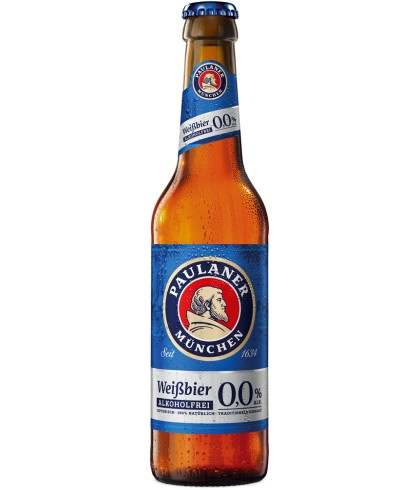
Paulaner Hefe Weizen Alcoholvrij 0.0
The same alcohol-free Hefe Weizen in the small bottle. 33 centilitres, 0.0 percent.
€ 1,50
From monastery beer to Munich large-scale brewery
- The brand in four facts
- 1634First official mention of the beer of the Paulaner friars; that year is regarded as the founding date.
- 1751The friars receive an official licence to serve.
- 1799The monastery of Neudeck ob der Au is dissolved.
- 1806Master brewer Franz Xaver Zacherl buys the former monastery brewery.
The name Paulaner refers to the Paulaner order, founded by Francis of Paola in southern Italy. Between 1627 and 1629 that order took over the Neudeck ob der Au monastery near Munich.
The friars were brewing their own beer by 24 February 1634 at the latest. On that day, the Munich burgher brewers lodged a complaint with the mayor to have the sale of the monastery beer banned. The complaint achieved nothing, and that very first official mention is still regarded today as the brewery’s founding date.
The beer that could be served on the feast days of the order’s founder was a bock beer. After the monastery was dissolved, brewmaster Franz Xaver Zacherl bought the brewery in 1806 and continued the bock tradition under the name Salvator.
Weissbier is a completely different school from that bock beer. It is top-fermented and brewed with a large share of wheat malt. The aromas typical of such a beer develop during fermentation: isoamyl acetate is responsible for the light banana note, ferulic acid for the phenolic note reminiscent of clove. A regular Bavarian weizen comes in at around five to six percent alcohol.
There are two main routes to alcohol-free beer. The brewer can limit fermentation or stop it early, with a special yeast or at a lower temperature, so that hardly any alcohol forms. Or he first brews a full beer and then removes the alcohol, by heating or vacuum distillation; aromas evaporate along with it, and these are returned in the process.
Almost every large Bavarian wheat beer brewery now makes an alcohol-free weizen. Paulaner, Erdinger, Maisel’s and Weihenstephaner are all four on our alcohol-free shelf.
Alcohol-free, 0.0 and low-alcohol
The label on these bottles states 0.0 percent. In the Netherlands, a beer may be called alcohol-free if it contains less than 0.1 percent alcohol. Between 0.1 and 1.2 percent it is called low-alcohol. So in the Netherlands a beer of 0.3 percent is not alcohol-free but low-alcohol.
So 0.0 on the label means: below that limit of 0.1 per cent. It is a labelling term, not an arithmetical zero.
In other countries the limits are different. Belgium uses 0.5 per cent, Spain 1 per cent, France and Italy 1.2 per cent. As a result, the same beer may be called alcohol-free in one country and not in another.
View Paulaner alcohol-free in the online shop
Two bottles, with current price and stock.
Frequently asked questions about Paulaner alcohol-free
Which alcohol-free Paulaner does ’t Bockje have in stock?
Two bottles of Paulaner Hefe Weizen Alcoholvrij 0.0: one of 50 centilitres and one of 33 centilitres. Both available for immediate delivery.
How much alcohol does it contain?
The label says 0.0 per cent; the label information in our online shop says 0% vol. In the Netherlands a beer may be called alcohol-free up to 0.1 per cent alcohol.
What is the difference between 0.0 per cent and low-alcohol?
In the Netherlands a beer is called alcohol-free up to 0.1 per cent and low-alcohol from 0.1 to 1.2 per cent. A beer of 0.3 per cent therefore counts as low-alcohol here.
Is this the same beer style as the regular Paulaner Weißbier?
Yes, it is a top-fermented wheat beer. The alcohol content differs: a regular Bavarian weizen is around five to six percent, this one is 0.0 percent.
Where does Paulaner come from?
From München. The name refers to the Paulaner order, which took over the Neudeck ob der Au monastery near München. The first official mention of the beer dates from 24 February 1634.
Why does a weizen smell of banana and clove?
These aromas arise during fermentation. Isoamyl acetate is responsible for the banana note and ferulic acid for the phenolic note reminiscent of cloves.
Can I pick up Paulaner alcohol-free in Bathmen?
Yes. You can always order online or collect at Brink 2, or simply drop in during our opening hours.
Order, collect or drop by
- In stock in our shop at Brink 2 in Bathmen
- Available to order online and have delivered, including abroad
- Order online or collect in Bathmen
- Personal advice via 0570 541 278 or info@bockje.nl
- Opening hours: Tuesday to Friday 09.00–18.00, Saturday 09.00–17.00. Closed Monday and Sunday
Wij verkopen geen alcohol aan personen onder de 18 jaar. NIX18.
Keep browsing
Brink 2, Bathmen
All our stock is in the shop, not in a warehouse somewhere else. If you walk in with a name you couldn't find anywhere, it is often simply here on the shelf. You can also call: 0570 541 278.
Wij verkopen geen alcohol aan personen onder de 18 jaar. NIX18
- Tuesday to Friday 09.00 – 18.00
- Saturday 09.00 – 17.00
- Monday and Sunday closed