
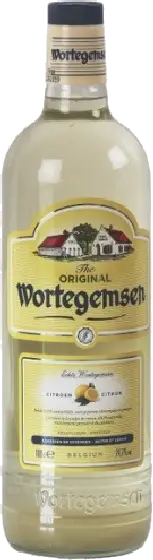
From the shelf
Everything we have from Wortegemsen
Click on a bottle for the rest of the details.
The only Fleming on this shelf
Between the Dutch berries and lemons stands one Belgian: Wortegemsen. It is a lemon jenever from the border region of West and East Flanders, where that drink was traditionally made at home from jenever, sugar and lemons.
The special thing is in the preparation. Most lemon jenevers and also limoncello get their flavour from lemon peel steeping in the drink. With Wortegemsen, lemon pulp goes in. As a result, sediment sinks to the bottom of the bottle and you need to shake it before pouring.
We have a few, no more. Call 0570 541 278 if you would like to know whether there is any left before you drop by.
The bottle we have in stock
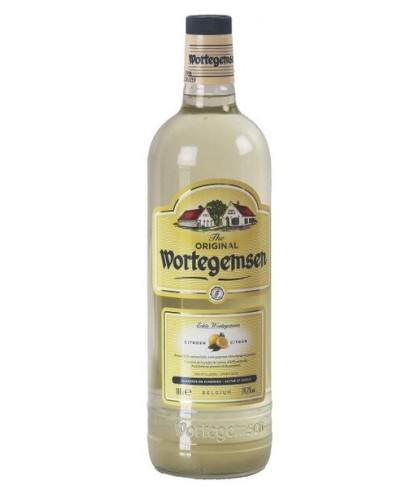
Wortegemsen
Flemish lemon jenever with lemon pulp, 24.2 percent, one litre. Shake before use.
€ 19,99
From kitchen table to half a million litres
- The brand in brief
- 1752The year of the Oude Stokerij in Wortegem that is on the label.
- 1978Spirits importer Albert Kint from Waregem registers the name.
- 1990Around this year production peaks at half a million litres a year.
- 2009The Kint family sells the brand to Graanstokerij Filliers.
Lemon jenever was an everyday home drink in the border region of West and East Flanders: jenever, sugar and lemons, and then wait. In 1978 drinks importer Albert Kint of Waregem registered the name Wortegemsen and brought it to market in a systematic way. The label of the litre bottle shows an image of the Oude Stokerij in Wortegem from 1752, where the mixture is said to have originated according to tradition.
Why you need to shake
Unlike many other lemon jenevers, and unlike limoncello, Wortegemsen does not get its flavour from lemon peel steeping in the spirit, but from added lemon pulp. That sediment sinks to the bottom of the bottle, so give it a quick shake before you pour.
The base product was bought elsewhere; the finishing took place at Albert Kint in Waregem. Around 1990 production was at its peak, at half a million litres a year. Aldi sold a comparable product under the name Waregemsen, and in the wake of its success other producers added lemon genevers, fruit genevers and berry genevers.
In February 2009 the Kint family sold the brand to Graanstokerij Filliers, itself a producer of fruit jenevers. Production had by then fallen to 250,000 litres a year. Since 2020 there has also been a Wortegemsen orange of 22 percent alongside the lemon; we stock the lemon.
Blackcurrant jenever, lemon brandy or fruit liqueur?
This shelf holds a mix of different things. It helps to know which is which.
Blackcurrant jenever is jenever in which blackcurrants have steeped, sometimes with raspberries, and usually sweetened with sugar. The colour is wine red and the alcohol content is at least twenty per cent.
Lemon jenever is an old preparation: lemons with jenever and sugar, with the mixture left to stand for about thirty days. Wortegemsen belongs to this group.
Citroenbrandewijn is the Dutch variant alongside it: sweetened distillate with herbs and lemon peel, sometimes with caramel for colour. Usually sweeter and, at around twenty percent, a little lighter than a lemon genever.
A fruit liqueur is a liqueur based on fruit. Every liqueur must have at least fifteen per cent alcohol and at least a hundred grams of sugar per litre. If a product stays below fifteen per cent, it is no longer called a liqueur but a likorette.
Fruit in the name does not make it a healthy product; it is still alcohol.
Frequently asked questions about Wortegemsen
Which Wortegems does ’t Bockje have in stock?
The original and the lemon, at 24.2 percent in a one-litre bottle.
Where does Wortegemsen come from?
From Flanders. The name refers to Wortegem; until 2009 the drink was finished in neighbouring Waregem.
Why do you have to shake the bottle?
Because it contains lemon pulp instead of lemon peel. That sediment settles at the bottom of the bottle.
Who owns the brand now?
From Graanstokerij Filliers, which took it over from the Kint family in February 2009.
What is the difference from limoncello?
Limoncello is made by steeping lemon peel. Wortegemsen gets its flavour from lemon pulp, on a jenever base.
How much alcohol does it contain?
24.2 percent according to the label.
Can I pick up Wortegemsen in Bathmen?
Yes. You can always order online or collect at Brink 2, or simply walk in.
Order, collect or drop by
- In stock in our shop at Brink 2 in Bathmen
- Available to order online and have delivered, including abroad
- Order online or collect in Bathmen
- Personal advice via 0570 541 278 or info@bockje.nl
- Opening hours: Tuesday to Friday 09.00–18.00, Saturday 09.00–17.00. Closed Monday and Sunday
Wij verkopen geen alcohol aan personen onder de 18 jaar. NIX18.
Keep browsing
Brink 2, Bathmen
All our stock is in the shop, not in a warehouse somewhere else. If you walk in with a name you couldn't find anywhere, it is often simply here on the shelf. You can also call: 0570 541 278.
Wij verkopen geen alcohol aan personen onder de 18 jaar. NIX18
- Tuesday to Friday 09.00 – 18.00
- Saturday 09.00 – 17.00
- Monday and Sunday closed