Whisky · Explainer
How much water does it take to make a bottle of whisky?
Nobody publishes a hard figure per bottle. The Scotch Whisky Association counts in litres of water per litre of pure alcohol and aims for 12.5 to 25 l/lpa. A 70 centilitre bottle at 40 percent contains 0.28 litres of pure alcohol, so 3.5 to 7 litres of process water per bottle. Cooling water falls outside this: with cooling included, research arrives at about 100 litres per litre of alcohol, some 28 litres per bottle.
In brief
The key figures
| Unit of calculation of the industry | Liters of water per liter of pure alcohol, abbreviated l/lpa |
|---|---|
| Scope of the Scotch Whisky Association | 12.5 to 25 l/lpa in 2025, depending on size and production |
| Converted per 70 cl bottle at 40 percent | 0.28 litres of pure alcohol, so 3.5 to 7 litres of process water |
| Cooling water included | About 100 litres of water per litre of alcohol, so around 28 litres per bottle |
| Share of cooling water | 80 percent of the water that Scottish distilleries abstract, SEPA 2019 figures |
| Water in the bottle itself | 70 cl at 40 percent: about 42 cl water; at 60 percent: about 28 cl |
| Legal minimum | 40 percent alcohol, Scotch Whisky Regulations 2009, regulation 3 |
| Licence required in Scotland | Above 50 cubic metres per day a permit from SEPA is required |
Where does all that water in the process go?
The water goes to five places: mashing, diluting the wash, cooling the condensers, cleaning the plant, and reducing to bottling strength.
During mashing, hot water is poured over ground malt to release the fermentable substances. The mash is then brought down with water to the strength at which the yeast can work. After distilling, water is added again before the spirit goes into the cask, and once more at the end to bring the whisky to the strength on the label. Cleaning water for the stills, the washbacks and the pipes runs alongside all year round.
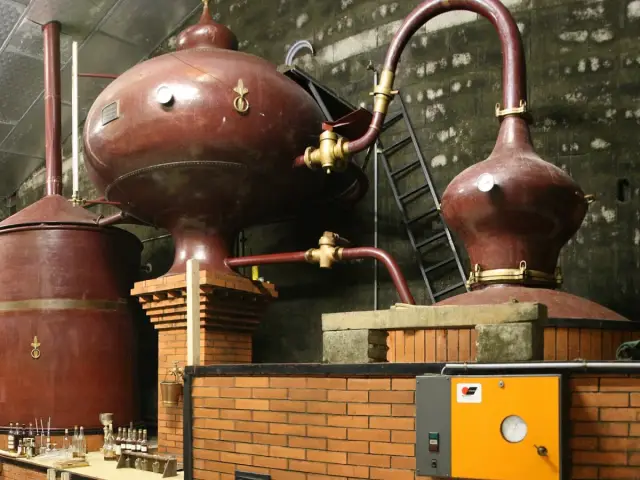
However, most of the water never comes near the whisky: cooling water for the condensers turns the alcohol vapor back into liquid and leaves the plant without touching the product. According to 2019 SEPA figures, cited in the research programme DWR UISCE, 80 percent of the water that Scottish distilleries abstract is cooling water.
What is the difference between process water and cooling water?
Process water ends up in the whisky or evaporates; cooling water never touches the product and, after use, largely returns to the stream or river it came from.
In the SEPA figures for 2019, cited by the research programme DWR UISCE, Scottish distilleries account for 70 percent of all licensed direct water abstractions by industrial and commercial users. Of that water, 80 percent is cooling water. An abstraction of hundreds of cubic metres a day therefore says little about how much water is actually taken from the region.
SEPA also takes that distinction into account in its rules. The drought guidance states that abstractions where the water is returned nearby do not qualify for suspension: within 500 metres in water bodies with high status, and within 1,500 metres elsewhere, as long as there is no significant effect. Anyone who loses the water to evaporation or to the product does not fall under this.
Why is there more water in a 40 percent bottle than in cask strength?
A bottle of 70 centilitres at 40 percent contains 28 centilitres of pure alcohol and about 42 centilitres of water; at 60 percent that is 42 and about 28 centilitres.
The difference is therefore a good fourteen centilitres of water per bottle. Anyone who bottles the same whisky at 40 percent instead of 60 percent also needs less spirit per bottle: 46.7 centilitres at 60 percent plus 23.3 centilitres of water gives exactly 70 centilitres at 40 percent. Those 23.3 centilitres are the bottling water, and that is the only water in this whole story that you actually find again in your glass.
Calculated the other way round, one litre of pure alcohol fills about 3.6 bottles of 70 centilitres at 40 percent, and about 2.4 bottles at 60 percent. Cask strength whisky gets no more water added at bottling. The lower limit is laid down by law: the Scotch Whisky Regulations 2009 require at least 40 percent alcohol and, besides water, allow only plain caramel colouring.
What about water scarcity in Scotland and the licensing requirement?
Abstraction is not free: above 50 cubic metres per day SEPA requires a licence, and in dry summers those licences are temporarily restricted.
Scotland works with three tiers. Below 10 cubic meters per day, general rules apply; between 10 and 50 cubic meters per day, the abstraction must be registered; and above that a licence is required. Abstractions of up to 10 cubic meters per day may also continue during a period of scarcity.
That the restrictions really bite became clear in 2025. On 11 September, 17 catchments were at the Significant Scarcity level, the highest number since the introduction of the current National Water Scarcity Plan, including the Lower Spey, the Deveron, the Findhorn and the Lower Dee. SEPA issued roughly 270 restrictions on abstraction licences that year, by its own account the highest number ever.
What is the industry doing to reduce consumption per litre?
Water efficiency in the Scottish whisky industry has improved by 22 percent since 2012, and since the summer of 2023 there has been a Water Stewardship Framework for consumption per distillery.
The Scotch Whisky Association measures in litres of water per litre of pure alcohol and, in its 2021 Sustainability Strategy, set a target range of 12.5 to 25 l/lpa for 2025, depending on the size of the distillery and on what is being distilled. The range is reviewed every two years; the trade association has announced that it will set stricter targets after that.
Where the gains lie has been mapped at Arbikie in the DWR UISCE research programme. Routing the cooling water differently and recovering the heat from it can reduce abstraction by up to 45 percent. Using the draff and pot ale as animal feed instead of imported soy meal offsets up to 47 percent of the water scarcity footprint.
From the shop in Bathmen
Which Scotch whisky is available in Bathmen?
The shop in Bathmen has 2,866 Scotch whiskies from 327 different brands. Prices range from € 5.99 to € 12,500.00. The alcohol percentage ranges from 10% to 66.8%.
- 1770 Glasgow Distillery 2nd Release 46% · 50 cl · Scotland
- 1770 Glasgow Distillery Red Wine & Ruby Port Cask Finish 57.5% · 70 cl · Scotland
- 1770 Glasgow Distillery The Original 46% · 70 cl · Scotland
- 1770 Glasgow Distillery The Original Cask Strength #2 59.5% · 70 cl · Scotland
- 1770 Glasgow Distillery Triple Distilled 46% · 70 cl · Scotland
- 1770 Glasgow Distillery Triple Distilled Release No.1 46% · 50 cl · Scotland
- 1770 Glasgow Distillery White Port Cask Finish 53.3% · 70 cl · Scotland
- 1770 Glasgow Single Malt 52% · 70 cl · Scotland
- A Highland Distillery 2005 – 16 Years Old – First Cask 58.3% · 70 cl · Scotland
- Abbot's Choice Figure Ceramic Monk 43% · Scotland
Related questions
Does whisky belong in a decanter?Is an older whisky always better?Can a bottle of spirits be shipped safely?
Short answer
Short answers to related questions
- Does the water for whisky come from its own spring?
- Many Scottish distilleries abstract from their own stream, loch or borehole. Above 50 cubic metres per day a licence from SEPA is required.
- Can water be added to Scotch?
- Yes. Besides water, the Scotch Whisky Regulations 2009 allow only plain caramel colouring, and the lower limit remains 40 percent alcohol.
- Does whisky at cask strength cost less water?
- There is less water in the bottle, because nothing is added at bottling. That changes nothing about the water in the distilling process itself.
- How much water is in a 3 centilitre glass of whisky?
- At 40 percent that is 1.2 centilitres of pure alcohol and about 1.8 centilitres of water. A few drops of water added lower the percentage further.
- Is cooling water wasted water?
- No. Cooling water does not touch the whisky and after use mostly goes back to the source, warmer than when it came out.
The reasoning
Sources
- Responsible water use, Scotch Whisky Association (accessed 2026-11-05)
- Whisky industry launches water stewardship framework, Scotch Whisky Association (accessed 2026-11-05)
- The Scotch Whisky Regulations 2009, regulation 3, legislation.gov.uk (accessed 2026-11-05)
- Arbikie Distillery carbon and water footprint, DWR UISCE, Interreg North-West Europe (accessed 2026-11-05)
- Surface water and groundwater abstraction, Scottish Environment Protection Agency (accessed 2026-11-05)
- Significant water scarcity guidance, Scottish Environment Protection Agency (accessed 2026-11-05)
- Scotland faces record water scarcity with 17 catchments at Significant, Scottish Environment Protection Agency (accessed 2026-11-05)
This page was written and checked by ’t Bockje Bathmen, wine & spirits shop at Brink 2 in Bathmen. Last updated on 5 November 2026.
Verkoop van alcohol onder de 18 jaar is verboden. NIX18.
 Whisky
 Beer
 Wine
 Spirits
 Aperitifs and specialities
 Alcohol-free
 Glasses and more
 Partnerships