Mimosa
According to the International Bartenders Association (IBA), you make a mimosa with equal parts freshly squeezed orange juice and sparkling wine: 75 ml of juice and 75 ml of prosecco. You first pour the juice into a flute, then slowly add the bubbles and stir gently. An orange zest is optional. Champagne, cava or crémant works too. In the shop on the Brink in Bathmen there are 127 sparkling wines and champagnes to choose from.
What you need
Glass: Flute (champagne glass). 1 cocktail
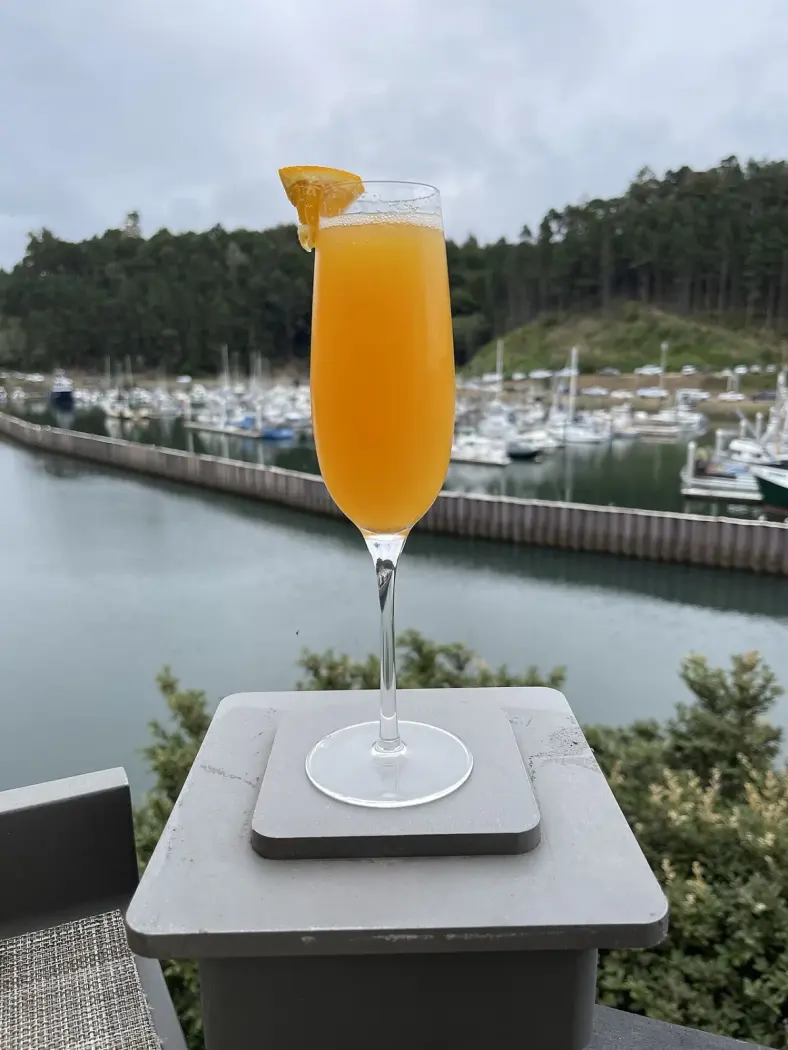
| 75 ml | Champagne or sparkling wine |
|---|---|
| 75 ml | Freshly squeezed orange juice, chilled |
| 1 piece | Orange zest (optional) |
How to make it
- Chill the sparkling wine and the orange juice well beforehand.
- Pour 75 ml freshly squeezed orange juice into a flute.
- Top up slowly with 75 ml sparkling wine, so the foam does not overflow.
- Stir very gently, so the bubbles stay.
- Garnish with a little orange zest if you like.
Garnish: Orange zest (optional)
What is a mimosa?
A mimosa is a cocktail of sparkling wine and orange juice in equal parts. The International Bartenders Association (IBA) lists it among the Contemporary Classics in its official list, with 75 ml freshly squeezed orange juice and 75 ml prosecco.
The origin is not entirely certain. According to Difford's Guide, the mimosa is attributed to Frank Meier of the Ritz Hotel in Paris, around 1921 to 1923. Meier included the drink in his 1936 book The Artistry of Mixing Drinks, under the name 'Mimosa or Champagne Orange', but did not claim it there as his own invention. So what is a mimosa in one sentence: a simple, light combination of bubbles and juice that is often served at a brunch or reception.
How do you make a mimosa?
You make a mimosa by first pouring the orange juice into a flute and then slowly adding the sparkling wine. That is the order the IBA prescribes. Then stir very gently, so that the carbonation is not lost. The ratio is one to one: 75 ml juice and 75 ml wine.
Difford's Guide gives the same ratio but a slightly different method: in a goblet with ice you pour half of the wine and the juice, stir briefly, and top up with the rest of the wine. That guide recommends a dry (brut) champagne and juice that is freshly squeezed and cold from the fridge. Anyone who wants to make mimosa for several glasses simply keeps the same ratio per glass and pours only just before serving.
The drinks for this recipe at ’t Bockje
Champagne or sparkling wine 127 in the shop


Which sparkling wine do you use for a mimosa: champagne, cava, crémant or prosecco?
For a mimosa you can use champagne, cava, crémant or prosecco; the IBA names prosecco, Difford's Guide a brut champagne. The difference lies in origin and method. According to the Comité Champagne, champagne comes from the region of the same name in the north-east of France, mainly from pinot noir, meunier and chardonnay. The second fermentation takes place in the bottle, and a non-vintage champagne ages at least 15 months in the cellar, a vintage at least 3 years.
According to the D.O. Cava, Cava is also made using the traditional method, with a second fermentation in the bottle; for the Cava de Guarda category the wine ages for at least nine months. Crémant, such as Crémant d'Alsace, is likewise a French sparkling wine made by the traditional method with a second fermentation in the bottle. According to the Consorzio, Prosecco DOC comes from Veneto and Friuli-Venezia Giulia, consists of at least 85 percent glera and gets its bubbles in large tanks (the Martinotti method).
What is the difference between a mimosa and a Buck's Fizz?
The difference lies mainly in the ratio and the ice. According to Difford's Guide a Buck's Fizz is two parts champagne to one part orange juice, without ice in a flute or coupe. A mimosa is equal parts champagne and juice, in historical recipes often with ice in a wine glass.
The Buck's Fizz was reportedly invented in 1921 by barman Malachi 'Pat' MacGarry of Buck's Club in London, although Difford's calls the evidence for that thin. Harry Craddock included it in 1930 in The Savoy Cocktail Book. The IBA does not draw the distinction so sharply, incidentally: in its specification of the mimosa it states that the drink is also called 'Buck's Fizz'. If you want to taste the difference, make both with the same bottle and compare the proportions.
Can you make an alcohol-free mimosa?
Yes, you make an alcohol-free mimosa by replacing the sparkling wine with an alcohol-free sparkling wine or another sparkling, dry alternative. The rest of the recipe stays the same: first 75 ml of freshly squeezed orange juice in the flute, then slowly add 75 ml of bubbles, and stir gently.
An alcohol-free mimosa is not an official IBA recipe, so you have some room. Preferably choose a dry variant, because the orange juice itself is already sweet enough. Chill everything well beforehand, because ice dilutes the drink. That way you can pour the same drink at the table for guests with and without alcohol, in the same glass and with the same orange zest as garnish.
Which champagnes and sparkling wines are in stock at ’t Bockje?
At ’t Bockje, champagnes, cava, crémant and prosecco stand side by side, so you can choose for your mimosa. Anyone following the IBA takes a prosecco such as Costaross Prosecco. For a cava there is Vilarnau Cava Brut Reserva, for a crémant Langlois-Chateau Crémant de Loire Rosé 'Cuvée LC'. There are also, for example, Bellussi Cuvée Prestige VSQ Brut and Henkell Trocken.
If you would like to make the mimosa with champagne, as Difford's Guide recommends, we stock Ernest Rapeneau Blanc De Blancs and Veuve Clicquot Rosé, among others. Not sure which bottle suits your occasion? Feel free to call 0570 541 278 or drop by ’t Bockje at Brink 2 in Bathmen.
What customers also ask
What is a mimosa?
A cocktail of sparkling wine and fresh orange juice in equal parts, classified by the IBA among the Contemporary Classics.
How do you make a mimosa?
You pour 75 ml of fresh orange juice into a flute, slowly top up with 75 ml of sparkling wine and stir gently.
What other mimosa recipes are there?
Difford's Guide mentions, among others, the Grand Mimosa with a splash of orange liqueur and the Puccini with mandarin juice, mandarin liqueur and prosecco.
Is an alcohol-free mimosa possible?
Yes, replace the sparkling wine with a non-alcoholic bubbly and keep the same ratio and order.
Should there be ice in a mimosa?
The IBA prescribes no ice and serves it in a flute; Difford's Guide serves it in a goblet with ice.
Keep browsing
Sources
- Mimosa, International Bartenders Association, iba-world.com/iba-cocktail/mimosa/ (accessed 15 October 2026)
- Buck's Fizz & Mimosa Cocktails, history & recipes, Difford's Guide, diffordsguide.com/encyclopedia/1244/cocktails/bucks-fizz-and-mimosa-cocktails-history-and-recipes (accessed 15 October 2026)
- Mimosa, Difford's Guide, diffordsguide.com/cocktails/recipe/1324/mimosa (accessed 15 October 2026)
- Champagne frequently asked questions, Comité Champagne, champagne.fr/en/champagne-frequently-asked-questions (accessed 15 October 2026)
- Cava aging: the Cava production process, D.O. Cava, cava.wine/en/news-articles/cava-aging-the-cava-production-process/ (accessed 15 October 2026)
- Production regulation, Consorzio Tutela Prosecco DOC, prosecco.wine/en/prosecco/production-regulation/ (accessed 15 October 2026)
- Crémant d'Alsace (AOP), INAO, inao.gouv.fr/node/30781/printable/pdf (accessed 15 October 2026)
The shop is at Brink 2 in Bathmen. Open Tuesday to Friday from 09.00 to 18.00 and Saturday from 09.00 to 17.00. For advice, call 0570 541 278 or email info@bockje.nl.
Wij verkopen geen alcohol aan personen onder de 18 jaar. NIX18.
 Whisky
 Beer
 Wine
 Spirits
 Aperitifs and specialities
 Alcohol-free
 Glasses and more
 Partnerships