The short answer to this question is on the question page What is Old Tom gin?. Below you can read the full story behind it.
Of the 482 gins in Bathmen, exactly one is an Old Tom. That is not a buying mistake. It is the state of play: the style had almost disappeared, and of the makers who are taking it up again there are still only a few.
Old Tom is the sweetened gin. It sits between the dry English style and the full-bodied Dutch spirit, and it is the gin prescribed in nineteenth-century cocktail books. Anyone who makes a recipe from back then to the letter with a modern dry gin gets something different in the glass than the creator intended.
Old Tom is nowhere in the law
This is the first thing you need to know, and it explains the rest. The European regulation on spirit drinks recognises gin, distilled gin and London gin. Old Tom does not appear in it. There is no definition, no minimum, no maximum, no control.
Old Tom is therefore not a category but a custom. A maker who puts the name on the bottle follows a tradition that he interprets himself. Legally, such a bottle is simply gin or distilled gin, with everything that goes with it: at least 37.5 percent alcohol and juniper as the main flavour.
It also means that the name in itself guarantees nothing. With London Dry you know exactly where you stand. With Old Tom you have to look at the bottle, at the maker, and sometimes simply at the ingredients list.
The sugar is the whole story
What makes Old Tom Old Tom is the sweetening after distillation. And the law does provide a framework for that, albeit indirectly.
For London gin, the upper limit is 0.1 gram of sugar per litre. That is a tenth of a gram: in practice nothing. For liqueur, by contrast, there is a lower limit of 100 grams per litre. In between lies a gap of a factor of a thousand, and it is precisely in that gap that Old Tom lives.
For the categories gin and distilled gin the regulation prescribes no sugar limit. A maker may therefore sweeten and still call the product gin, as long as it stays under a hundred grams, because above that it becomes liqueur.
How much actually goes in differs per house, and it is almost never stated on the label. Some makers add so little that you do not recognise it as sweet, only as rounder. Others go further. There is no benchmark, because nothing is prescribed.
Another variant: some makers add no sugar at all and draw the impression of sweetness from the botanicals, liquorice root for example. That too may call itself Old Tom, because nothing prohibits it.
Why an Old Tom can never be London Dry
This is the sharpest consequence of that 0.1 gram. As soon as a maker adds sweetness after distilling, he forfeits the right to the designation London gin. Even if his still stands in London, even if he does everything else by the book.
The two designations therefore exclude each other. You will never see them together on one bottle, and if you ever do see them together, something is wrong.
The same goes for colour. London gin may not be coloured. An Old Tom may be, and some examples therefore have a light golden tint, or because they have been aged in cask.
The cocktails that call for Old Tom
This is where it gets practical. The classic cocktails were devised at a time when the dry English style did not yet dominate. What the recipes called gin was often Old Tom, and the rest of the recipe is balanced accordingly.
The Martinez is the clearest example. Gin, sweet vermouth, maraschino, bitters. With a bone-dry gin that drink falls apart into sharp angles. With an Old Tom it comes together.
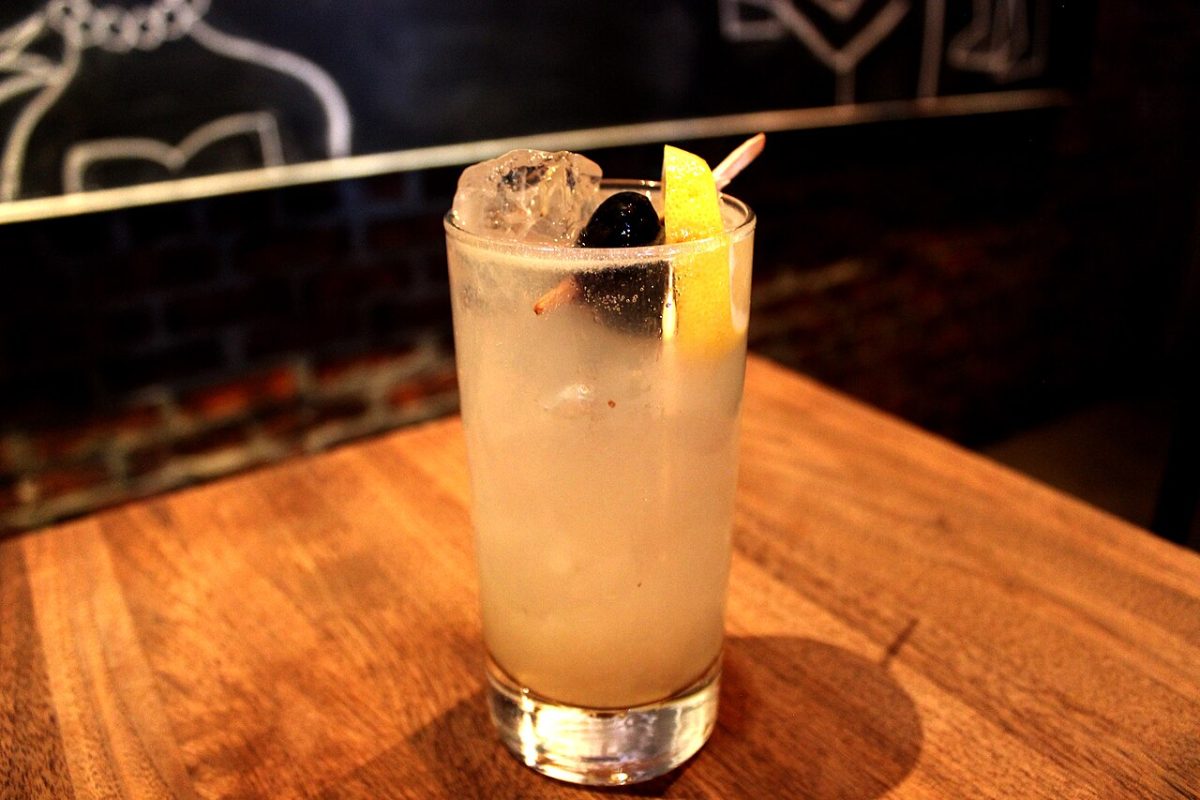
The Tom Collins carries the name in its title. Gin, lemon juice, sugar, soda water. With an Old Tom you need less sugar syrup, because part of the sweetness is already in the spirit.
The Ramos Gin Fizz and related fizzes work on the same principle. And the Gin Fix and Gin Punch from the old bar guides assume that the gin itself already brings something.
What you notice when you try it: the sweetness is not the main thing. It is a binder. It ties sharp sour and bitter elements together, so you taste one drink instead of three separate parts.
Why the style almost disappeared
When distillation technique improved, sweetening became less necessary. Sugar in gin was originally partly a correction: it covered up what was unpleasant in raw alcohol. As soon as makers could distil more cleanly, the reason disappeared, and the dry style won.
Then came the fashion in taste. The dry martini became the benchmark and everything sweet fell out of favour. Old Tom became almost a historical concept, only to be found in old recipe books.
That it is back is thanks to the bar side, not the drinkers' side. Bartenders who started recreating the old recipes ran into the problem that the ingredient no longer existed. A number of distilleries stepped in.
Where to start
Our only Old Tom comes from Zuidam in Baarle-Nassau, and is available in two sizes. If you want to taste what the sweetening does, put it next to a dry gin and make the same Tom Collins twice. Change nothing else. The difference is bigger than you would think on paper.
Keep browsing
What the designation London Dry does lay down is covered in a separate article. And because Old Tom comes close to Dutch jenever in terms of roundness, the piece about gin and jenever is also worth reading.
All bottles are on the gin page, with the Dutch makers separately on the page with Dutch gin and the genevers on the genever page. Searching by alcohol percentage or volume is quickest through the search engine of the wine & spirits shop.