Tawny port
Tawny port is port that matures in wooden casks or vats and is only bottled when it is ready to drink. A tawny is usually a blend of wines of different ages. The label may state an age (10, 20, 30, 40 or 50 years) or a harvest year, in which case it is called colheita. In the shop at the Brink in Bathmen there are now 22 bottles of tawny port from Portugal.
- 22bottles in the shop
- 9brands
- 19–21%alcohol
What is tawny port?
Tawny port is a style of port that matures in wooden casks or vats. According to the Instituto dos Vinhos do Douro e do Porto (IVDP), a tawny comes from lots of wine that have spent different lengths of time in wood. Through that maturation the colour changes from red to tawny, medium tawny or light tawny.
Like all port, tawny is made by stopping the fermentation with grape brandy, the so-called benefício. As a result, port usually has 19 to 22 percent alcohol according to the IVDP. A tawny is ready to drink as soon as it is bottled: the maturation takes place in the cask, no longer in the bottle.
What is the difference between ruby and tawny port?
The difference lies in how the wine is aged. With ruby port, according to the IVDP, the producer tries to slow the development of the deep red colour and to hold on to the character of a young wine. With tawny port, the producer instead lets the wine age for a long time in wood, so that colour and character change slowly.
The IVDP counts ruby, reserve, late bottled vintage (LBV) and vintage as the ruby style. Vintage and LBV in particular can go on maturing in the bottle for years afterwards. Tawny port, reserve tawny, tawny with an age statement and colheita belong to the wood-aged side. Anyone who wants to lay a bottle down to mature therefore tends to choose a vintage or LBV; a tawny is ready to drink at bottling.
Tawny port at ’t Bockje
A selection from the 22 bottles currently in the shop on the Brink.


In brief
| Origin | Portugal, supervised by the IVDP |
|---|---|
| Ageing | In wooden casks or vats, ready to drink at bottling |
| Alcohol | Usually 19 to 22 percent |
| Ages on the label | 10, 20, 30, 40 and 50 years |
| Colheita | A single vintage, at least seven years in the cask |
| Colour | Tawny, medium tawny or light tawny |
| In the shop | 22 bottles |
What do 10, 20, 30 and 40 years mean on a tawny?
An age on the label indicates the character of the wine, not how old every drop is. According to the IVDP, a 10-year-old tawny carries the characteristics of a ten-year-old port. It remains a blend of wines from several years.
For a long time 10, 20, 30 and 40 years were the only permitted ages. Since a rule change by the IVDP, 50 years may also appear on the label, as trade magazine Harpers reports. At the same time the IVDP's interprofessional council approved the designation Very Very Old Tawny Port, for wines of more than 80 years.
What is a colheita?
A colheita is a tawny from a single harvest year. Whereas a tawny with an age indication is a blend of wines from several years, a colheita, according to the IVDP, comes from one year. The IVDP compares it to a tawny with an age indication of the same age.
A colheita ages at least seven years in the cask. According to the IVDP, the colour ranges, depending on age, from golden red to tawny. Like other tawnies, a colheita is ready to drink as soon as it is bottled. The difference from an age statement is therefore not in the way of ageing, but in the origin of the wine: a single year instead of a blend of years.
Which tawny port does ’t Bockje have?
The shop stocks 22 bottles of tawny port, all from Portugal. The brands are Kopke, Graham's, Niepoort, Ramos Pinto, Cálem, Delaforce, F. Martins, Offley and Sandeman.
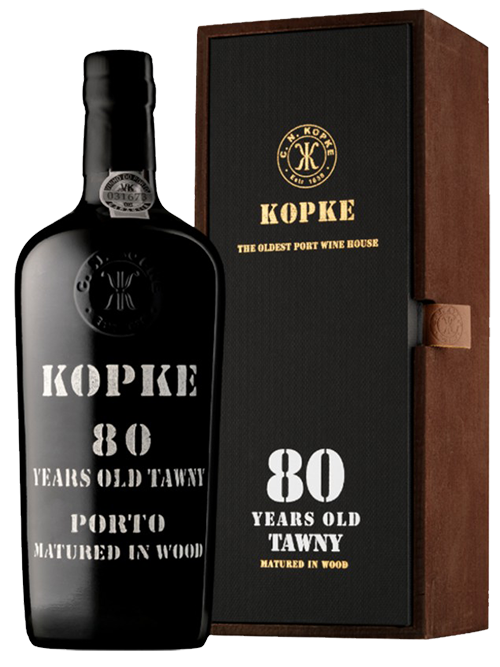
From Graham's, the Fine Tawny and the 10, 20 and 50 Year Old Tawny are on the shelf. From Kopke you will see the whole age range: 10, 20, 30 and 40 Years Old, and even an 80 Years Old Tawny. There are also the Kopke Reserve Tawny and the Kopke Fine Tawny, the latter also as a half bottle of 37.5 cl. Not sure whether to go for a young tawny, an aged tawny or a ruby? Feel free to call or drop by at Brink 2 in Bathmen.
Brands in this selection
- Kopke 8
- Graham's 4
- Niepoort 3
- Ramos Pinto 2
- Cálem 1
- Delaforce 1
- F. Martins 1
- Offley 1
- SANDEMAN 1
What customers also ask
Is a 20-year-old tawny really 20 years old?
Not every drop. It is a blend of several years that has the character of a 20-year-old port.
Does tawny port need to rest after purchase?
No. A tawny matures in the cask and is ready to drink as soon as it is bottled.
What is the difference between a colheita and a 10-year-old tawny?
A colheita comes from a single harvest year and matures for at least seven years in the cask; a 10-year-old tawny is a blend of several years.
Can tawny port also come from a single year?
Yes, that is called a colheita: a tawny from a single harvest year that has matured for at least seven years in the cask.
How much tawny port is in the shop?
Currently 22 bottles, from Kopke and Graham's to Niepoort, Ramos Pinto and Sandeman.
Keep browsing
Sources
- Port Wines: introduction, Instituto dos Vinhos do Douro e do Porto (IVDP), ivdp.pt/en/wines/port-wines/introduction/ (accessed 7 October 2026)
- Port Wines: special categories, Instituto dos Vinhos do Douro e do Porto (IVDP), ivdp.pt/en/wines/port-wines/special-categories/ (accessed 7 October 2026)
- Graham's unveils historic 50-Year-Old Tawny Port, Harpers Wine & Spirit, harpers.co.uk/news/fullstory.php/aid/32779 (accessed 7 October 2026)
- Vem aí vinho do Porto com mais de 80 anos, Dinheiro Vivo, dinheirovivo.dn.pt/vem-ai-vinho-do-porto-com-mais-de-80-anos-13995633.html (accessed 7 October 2026)
The shop is at Brink 2 in Bathmen. Open Tuesday to Friday from 09.00 to 18.00 and Saturday from 09.00 to 17.00. For advice, call 0570 541 278 or email info@bockje.nl.
Wij verkopen geen alcohol aan personen onder de 18 jaar. NIX18.
 Whisky
 Beer
 Wine
 Spirits
 Aperitifs and specialities
 Alcohol-free
 Glasses and more
 Partnerships