The short answer to this question is on the question page What is Irish whiskey?. Below you will find the whole story behind it.
Of the 1,764 whiskies on our shelves in Bathmen, 145 come from Ireland. After Scotland, that is the largest group. Yet it is the corner where most misunderstandings arise, and that starts with the word on the label.
One bottle says whisky, the other whiskey. That is not carelessness on the printer’s part.
Why Ireland adds an e
Both words come from the same Gaelic: uisce beatha, water of life. In the nineteenth century Irish whiskey from Dublin was known as the better product and Scotch as the cheaper competitor. The big Dublin houses added an e to make that difference visible. That extra letter travelled to the United States, where many Irish distillers moved, and there it still appears on most bottles.
It is a matter of spelling and nothing more. That letter says nothing about how the whiskey was made. Not all Irish distilleries stick to it themselves either. On bottles from Waterford and Teeling you will come across both forms. Whether you search our site for Irish whisky or Irish whiskey, you will land on the same page.
Three times through the still
The practice most people associate with Ireland is the third distillation. In Scotland the distillate usually goes through a copper still twice, in Ireland traditionally three times.
Each pass through the still does two things. The alcohol content of the raw distillate rises, and the distiller again cuts away the heads and tails. What remains after three passes is narrower in composition: less of the heavy, oily components, more of the light ones. That is why Irish whiskey often comes across as softer and smoother than Scotch. It is neither better nor worse, it is a different choice within the same craft.
What is rarely mentioned: it is not a law. Nowhere does it say that Irish whiskey must be distilled three times. Cooley in County Louth deliberately distils twice and also makes peated malt, something long regarded as typically Scottish. Anyone who thinks Irish whiskey is by definition light and smoke-free has not yet had those bottles in hand.
Single pot still, a category that only Ireland has
The real Irish peculiarity appears on bottles as single pot still. That is not an invented sales term but a distinct type of whiskey, and it exists nowhere else in the world.
With a single malt only malted barley goes into the still. With single pot still, unmalted barley goes in as well: raw, green barley that was not allowed to germinate. The reason was fiscal. The British crown levied tax on malted grain in the eighteenth century, and Irish distillers brought that bill down by leaving part of their barley unmalted. What began as a saving gave the distillate its own character: a thicker, oily structure and a spicy, slightly peppery edge.
By now the category is fixed in rules. It must contain at least thirty percent malted and at least thirty percent unmalted barley, distilled together in a copper pot still. Names such as Redbreast, Green Spot, Yellow Spot and Powers fall under this. If you want to understand what sets Irish whiskey apart, this is the starting point.
From more than a hundred distilleries to two
Around 1880 Dublin was one of the most important whisky cities in the world. Ireland had well over a hundred licensed distilleries and exports went all over the world. A century later only two were left.
All sorts of things piled on top of that. Prohibition closed off the United States, by far the biggest market. The trade war with Great Britain after Irish independence closed off the British Empire. Two world wars made grain scarce. And while Scottish houses used the column still to make cheap blends that conquered the world, the Irish houses long refused to join in. Column whisky was, in their eyes, not real whiskey. That stance of principle very nearly finished them off.
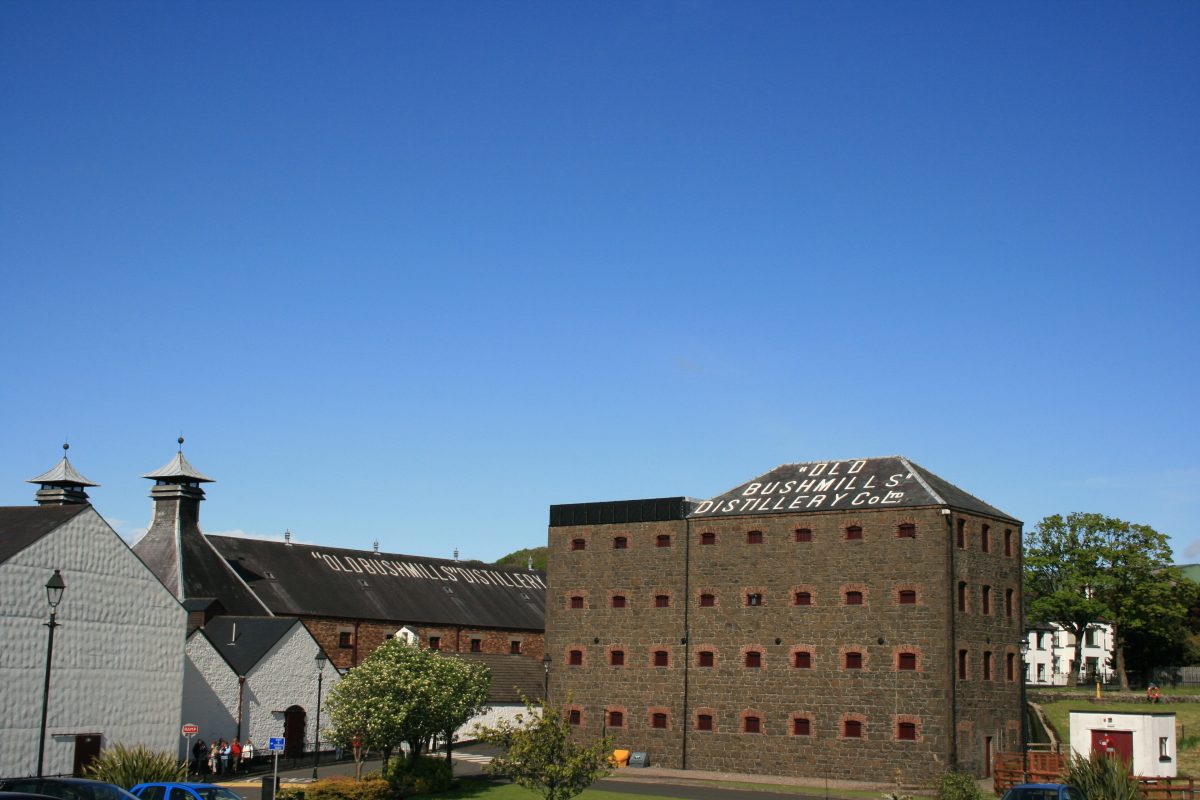
In 1966 the last remaining southern distilleries were forced to merge into Irish Distillers, and in 1975 they moved everything into a new plant next to the old Midleton distillery in County Cork. In the north, Bushmills remained. Two addresses, for an entire country.
The revival of the last twenty years
The turnaround began in 1987, when John Teeling converted that old factory in County Louth into the Cooley distillery. For the first time in decades there was once again an independent Irish distiller. Cooley revived dormant names such as Kilbeggan and Tyrconnell and, with Connemara, established a peated Irish malt.
After that, things moved quickly. In Dublin distilling resumed after more than a century when the Teeling sons opened their own distillery in The Liberties district. Houses were added in Dingle, in Clonakilty, in County Down with Hinch and in the Boyne Valley with Boann. In County Waterford a former brewery switched to whisky, with a method in which the barley from each farm is kept, fermented and distilled separately, so that you can follow what the soil does.
Where Ireland had two distilleries forty years ago, there are now dozens. A good share of them are still too young for old whiskey, so much of what is on the shelves now is still bought-in distillate from the big houses, matured and bottled under a new name. That will shift in the coming years. So, as with Japanese whisky, ask for the name of the distillery and not just the brand.
Where to start
The 145 Irish bottles we have on the shelf cover all directions of this story. There are soft, triple-distilled blends, there are single pot stills with that typical thickness, and there are single malts from the new houses, peated and unpeated. What suits you depends mainly on what you drink now. Come by in Bathmen or call 0570 541 278, and we will look with you.
Keep browsing
You will find all the Irish bottles together on our page whisky from Ireland. For each house you will find the background and the range: Redbreast, Green Spot, Yellow Spot, Powers, Jameson, Midleton Very Rare, Bushmills, Tullamore D.E.W., Kilbeggan, Tyrconnell, Connemara, Teeling, Waterford, Writers’ Tears, The Irishman, Hinch, Dingle, Clonakilty and Boann.
An overview of all the brands we stock is on whisky brands, and the whole whisky department starts at whisky. If you would like to browse the stock yourself, you can do so in the Wine & spirits search engine.
What the terms on the label mean exactly, we explain in single malt, blended and grain. And if you want to compare Ireland with the other whisky countries, read Scotland, Ireland and Japan: three whisky countries side by side.